



Key Takeaways
- Probability-weighted analysis projects SOL reaching approximately $485 by 2031
- Base scenario forecasts $350–$500, contingent on Solana maintaining its top-tier blockchain status
- Bullish outlook targets $900–$1,200 driven by payment adoption, stablecoin dominance, and ETF approval
- Bearish scenario estimates $70–$120 if Ethereum Layer 2 solutions and competitors erode market share
- Primary challenges include regulatory headwinds, competitive pressure, and demonstrating utility beyond speculative trading
Solana emerged as a high-speed, low-cost blockchain platform designed to compete with Ethereum. Since launch, it has evolved into a major cryptocurrency ecosystem, powering decentralized trading platforms, stablecoin infrastructure, payment systems, and consumer-facing applications.
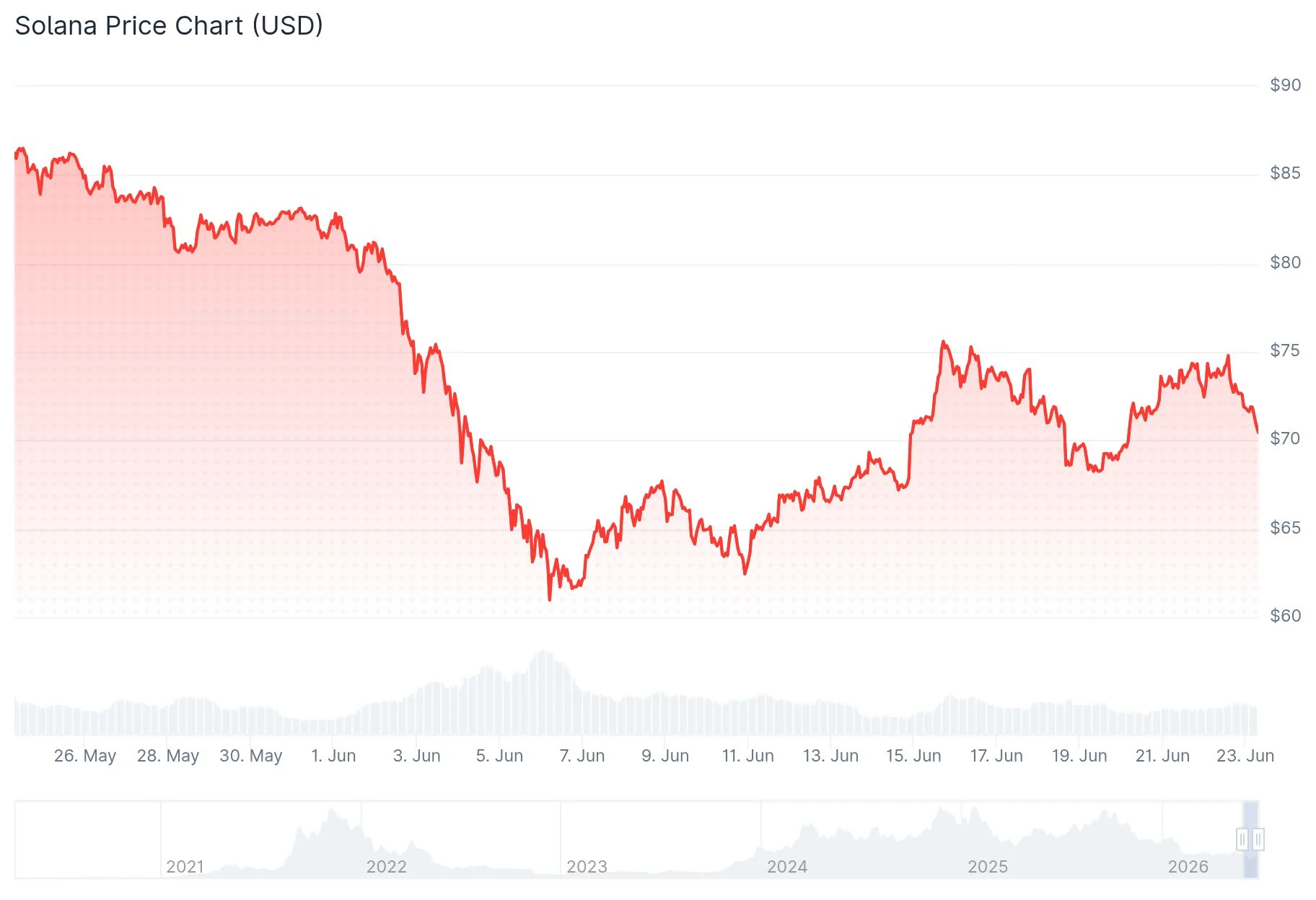
The central question facing investors is: what trajectory will SOL follow over the next five years?
This long-term analysis presents three distinct scenarios — bearish, baseline, and bullish — culminating in a probability-weighted projection of roughly $485 by 2031.
The baseline scenario carries a 50% probability weighting. Under this framework, cryptocurrency markets continue expanding, Bitcoin maintains market leadership, Ethereum preserves its ecosystem strength, and Solana secures its position as the premier high-throughput blockchain platform.
Assuming a circulating supply approaching 700 million SOL tokens, achieving a market capitalization between $250 billion and $350 billion would position prices in the $350 to $500 range.

This projection doesn’t demand that Solana surpass Ethereum in valuation. Rather, it requires consistent expansion in user adoption, application development, and real-world implementation.
Bullish Scenario Breakdown
The optimistic projection assigns a 25% probability with price targets between $900 and $1,200.
Reaching this valuation tier would require Solana to achieve dominance across multiple verticals — consumer applications serving millions of active users, substantial stablecoin transaction volume, and significant tokenized real-world asset activity.
Approval of a spot Solana exchange-traded fund represents another catalyst. Traditional finance capital entering through ETF vehicles would create sustained demand while positioning SOL alongside Bitcoin and Ethereum as an institutional-grade digital asset.
Under these conditions, Solana’s network valuation could climb to $700–$850 billion, justifying prices at the upper boundary of projections.
Bearish Outlook and Critical Challenges
The pessimistic scenario also receives a 25% probability assignment, forecasting SOL prices between $70 and $120 by 2031.
This outcome assumes competitive forces prevail. Ethereum’s Layer 2 scaling solutions have accelerated development, while emerging Layer 1 blockchain platforms continue launching with improved features.
Regulatory intervention represents an additional concern. Policy shifts affecting cryptocurrency markets could suppress institutional participation and constrain trading volumes.
Solana must also prove its ecosystem generates sustainable economic value beyond short-term speculation. Meme token trading has driven substantial recent activity — an unstable foundation for long-term growth.
Even under bearish conditions, Solana would probably maintain its status among the industry’s most significant blockchain networks.
The composite probability-weighted valuation across all scenarios yields approximately $485 by 2031, calculated using the 50/25/25 distribution between baseline, bullish, and bearish outcomes.
Get 3 Free Stock Ebooks
Discover top-performing stocks in AI, Crypto, and Technology with expert analysis.
- Top 10 AI Stocks - Leading AI companies
- Top 10 Crypto Stocks - Blockchain leaders
- Top 10 Tech Stocks - Tech giants


