



Key Takeaways
- Savita Subramanian from BofA expresses negative sentiment toward megacap tech and Magnificent Seven stocks
- Extensive AI infrastructure investments may decelerate economic growth and impact professional employment sectors
- Technical analysis suggests a three-wave pullback could send the S&P 500 down to 6,850
- BofA maintains Wall Street’s most conservative S&P 500 target at 7,100
- Strategic opportunities identified in large-cap value positions across energy, financial services, and industrial sectors
Bank of America has issued a cautionary outlook for U.S. equities, with key strategists at the firm advising investors to adopt a more defensive posture as 2026 progresses.
Savita Subramanian, who leads U.S. equity and quantitative strategy at Bank of America, shared with Barron’s that her stance on equities remains “neutral to negative” when viewed at the index level. Her primary apprehension centers on mega-cap technology companies.
“I don’t see any reason to continue to buy Magnificent Seven or megacap tech stocks,” she said.
The Hidden Costs of AI Infrastructure Buildout
Subramanian highlights significant concerns about the artificial intelligence expansion. She draws a parallel to residential remodeling projects — they typically exceed both timeline and budget projections.
Her more pressing concern involves the economic impact during the AI infrastructure development phase. Given that consumer activity accounts for 70% of U.S. economic output, she observes AI beginning to quietly diminish white-collar employment opportunities.
She emphasized that corporations are already halting recruitment of recent college graduates — a demographic that has fueled consumer expenditure for three decades.

“A lot of the good news is priced into the market but not necessarily the bad,” she said.
Middle-class consumers, who represent the majority of spending expansion, are already shifting toward more economical options. Insurance premiums and other substantial expenses are climbing more rapidly for this demographic segment.
Subramanian further observed that long-term growth projections for the S&P 500 have reached heights unseen since the 1980s, describing this as “a little odd.”
Technical Analysis Points to Multi-Stage Decline
From a technical perspective, Paul Ciana, who serves as Bank of America’s Global Head of Technical Strategy, shares similar reservations.
Ciana projects the S&P 500 may decline through three distinct phases — described as a “three-wave correction” — potentially bottoming near 6,850.
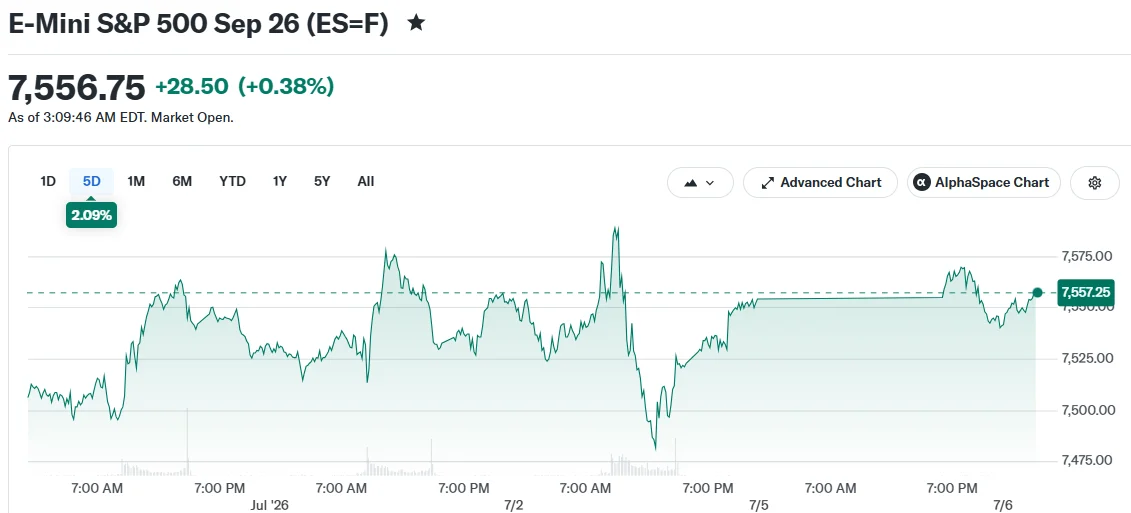
This scenario would translate to approximately an 8.5% decline from present trading levels.
He cautioned that should the index advance toward 7,741, it may represent a “bull trap” — a deceptive upward breakthrough that swiftly reverses direction.
Ciana characterizes current price movement as “stretched” and advises investors to adopt protective positioning throughout the July-September period.
Bank of America reaffirmed its year-end 2026 S&P 500 projection of 7,100 this week. This represents the most conservative estimate among major Wall Street firms and suggests roughly 5% downside from current valuations.
The institution points to diminishing liquidity conditions, reduced share repurchase activity, and declining institutional appetite as rationale for their cautious perspective.
Strategic Allocation Recommendations from BofA
Notwithstanding the pessimistic forecast, Subramanian identifies promising opportunities within specific market segments. She notes that every sector is experiencing earnings expansion this year.
Her preference leans toward large-cap value equities — especially within energy, financial services, and manufacturing industries. These segments continue to provide attractive dividend yields and buyback programs.
She also views semiconductor companies more favorably than hyperscalers, as chip manufacturers benefit from AI expenditures rather than incurring them.
Should new equity offerings continue their upward trajectory alongside rising long-term borrowing costs, she cautions this combination could precipitate a more widespread market downturn.
Get 3 Free Stock Ebooks
Discover top-performing stocks in AI, Crypto, and Technology with expert analysis.
- Top 10 AI Stocks - Leading AI companies
- Top 10 Crypto Stocks - Blockchain leaders
- Top 10 Tech Stocks - Tech giants


