


TLDR
- SpaceX (SPCX) shares climbed 7% following a remarkable week of rocket launches and orbital achievements.
- Three separate launches occurred within a 13-hour window, including an ISS crew transport, a Google satellite, and a classified government payload.
- The Starship vehicle successfully achieved Earth orbit and deployed 26 Starlink V3 satellites for the first time.
- Starlink operations generated $4.3 billion in quarterly revenue with $1.7 billion in operating profit.
- The AI computing division recorded a $1.3 billion quarterly loss but has secured contracts potentially worth $3.4 billion monthly.
Shares of SpaceX (SPCX) gained 7% on Friday as investors responded to an intense period of successful launches. The company executed three distinct rocket missions in fewer than 13 hours.
Space Exploration Technologies Corp., SPCX
Thursday kicked off the rapid-fire sequence with the Crew-13 mission for NASA. A Falcon 9 vehicle lifted off from Cape Canaveral carrying four astronauts bound for the International Space Station.
The Dragon spacecraft completed the journey in less than eight hours, setting a new speed record for American vehicles traveling to the ISS.
Julianna Scheiman, a director at SpaceX, attributed the record to favorable orbital mechanics. The station’s trajectory created optimal conditions for a direct approach.

The astronauts will conduct a six-month mission aboard the orbital laboratory. Meanwhile, the Falcon 9 first stage returned to Earth intact for potential reuse.
A Rapid-Fire Launch Sequence
Launch number two was the Transporter-18 rideshare flight, which carried 130 commercial satellites to orbit. Among the payloads was Google’s Project Suncatcher, an experimental platform for testing artificial intelligence processors in space.
Google designed the mission to evaluate how its TPU processors perform under space conditions, including cosmic radiation exposure and thermal cycling.
The booster supporting this mission completed its 25th flight, demonstrating SpaceX’s ongoing commitment to rocket reusability.
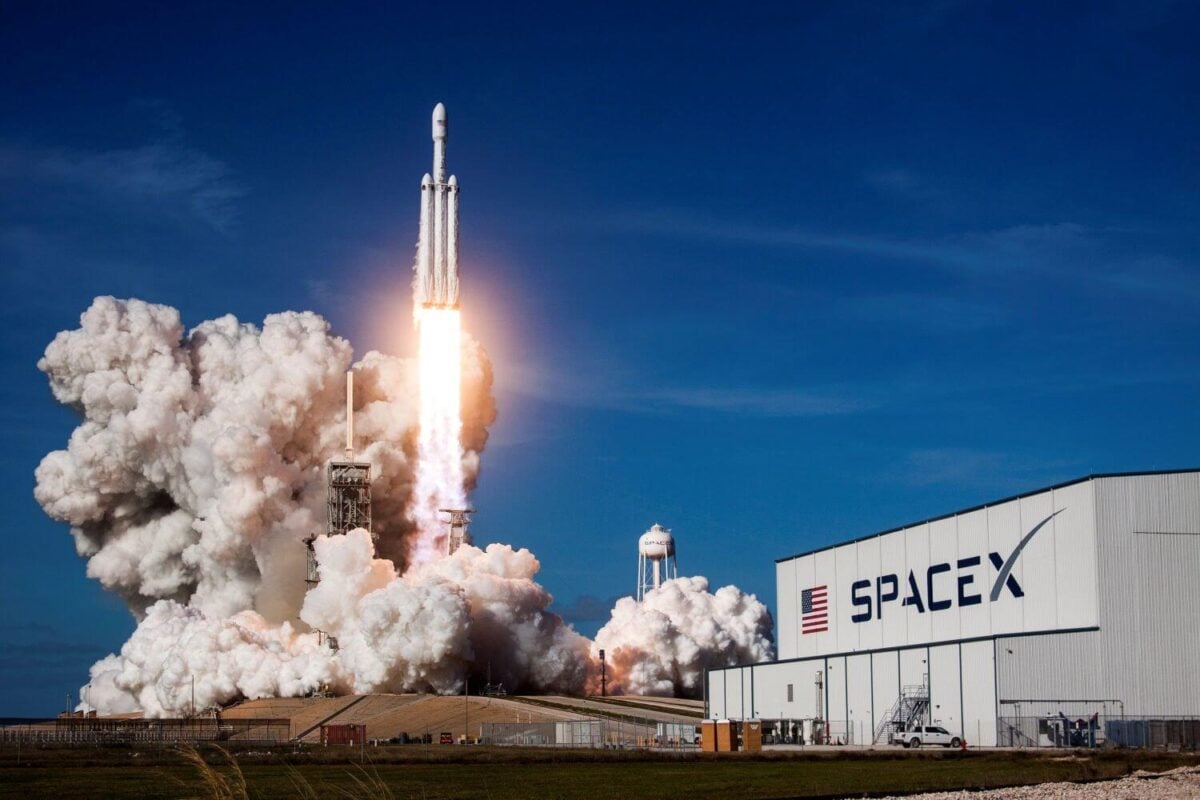
The third mission deployed a Falcon Heavy rocket carrying a secret payload for the National Reconnaissance Office. This marked the heavy-lift vehicle’s inaugural flight for the intelligence agency.
Both side boosters returned safely to landing zones in Florida. Combined across the three missions, SpaceX successfully recovered four booster stages.
Days earlier, the Starship vehicle achieved orbital flight for the first time. Despite losing one engine during ascent, it successfully deployed all 26 Starlink V3 satellites carried on the test flight.
Starship represents a critical component of SpaceX’s strategy to expand Starlink’s satellite constellation. Operational Starship flights are expected to dramatically reduce satellite deployment costs.
Jon Edwards, a SpaceX executive, described the week as extraordinary on social media platform X. He highlighted the deployment of four distinct vehicle types: Starship, Dragon, Falcon 9, and Falcon Heavy.
Financial Performance Across Business Segments
The Connectivity division, dominated by Starlink operations, continues to drive SpaceX’s financial performance. Last quarter, the segment delivered $4.3 billion in revenue alongside $1.7 billion in operating profit.
The Space division, encompassing launch services, showed contrasting results. It recorded a $542 million operating loss against $962 million in revenue.
The launch division’s loss stems partially from internal accounting practices. When SpaceX launches proprietary Starlink satellites, the Space division doesn’t recognize revenue for those flights.
Instead, the Connectivity business absorbs launch expenses and amortizes them via depreciation schedules. This accounting treatment inflates Starlink’s profitability while depressing the launch division’s reported performance.
SpaceX’s nascent AI division represents the company’s latest strategic initiative. The unit reported a $1.3 billion loss on $2.6 billion in quarterly sales.
However, the division’s financial trajectory may shift rapidly. New contracts with Anthropic, Alphabet, and other clients for computational capacity could generate as much as $3.4 billion in monthly revenue at full utilization.
Scaling the AI infrastructure requires substantial investment. The division alone deployed $15.8 billion in capital expenditures during the most recent quarter.
Get 3 Free Stock Ebooks
Discover top-performing stocks in AI, Crypto, and Technology with expert analysis.
- Top 10 AI Stocks - Leading AI companies
- Top 10 Crypto Stocks - Blockchain leaders
- Top 10 Tech Stocks - Tech giants


