



Key Highlights
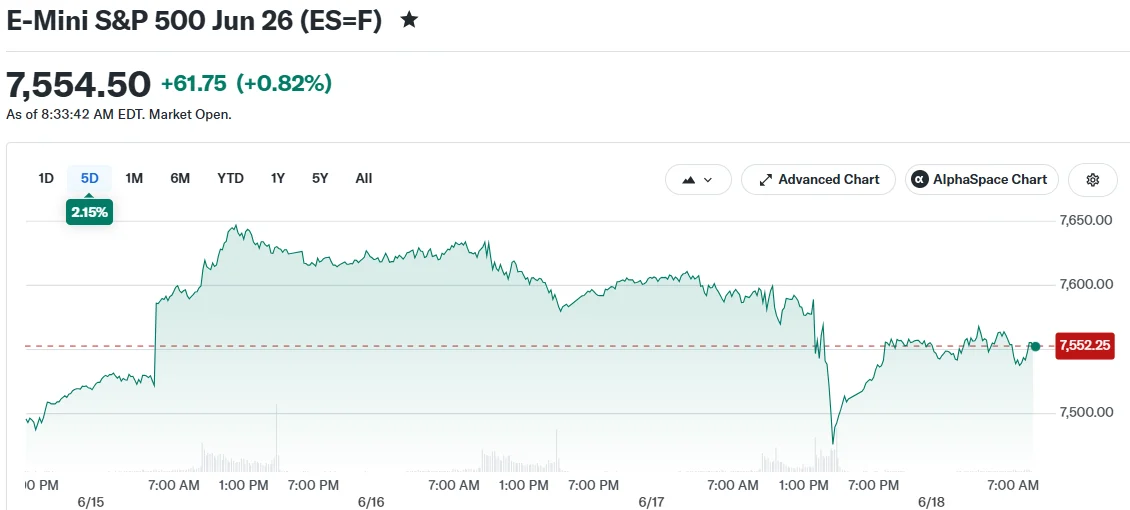
- Nasdaq 100 futures surged 1.3% while S&P 500 futures gained 0.7% in Thursday pre-market trading
- Trump administration finalized US-Iran peace framework Wednesday, ahead of Friday’s anticipated timeline
- Agreement could facilitate Strait of Hormuz reopening, potentially reducing global energy costs
- Brent crude oil plunged approximately 3% following the announcement, briefly trading under $78 per barrel
- Federal Reserve maintained current rates but indicated potential increase later in 2024, with October widely expected
US equity futures posted strong gains Thursday morning following a pair of significant market-moving events: the unexpected completion of a peace framework between the United States and Iran, alongside the Federal Reserve’s latest commentary on monetary policy direction.
The tech-heavy Nasdaq 100 futures outperformed with a 1.3% advance. S&P 500 futures climbed 0.7%, while Dow Jones futures showed modest strength with a 0.2% increase. Wednesday’s session had seen substantial declines across all three benchmark indices.
Unexpected Iran Agreement Completed
The Trump administration completed a memorandum of understanding with Iranian officials Wednesday evening, surprising markets that had anticipated a Friday ceremony. The comprehensive 14-point agreement establishes a diplomatic roadmap for normalized relations between Washington and Tehran.
Market participants are optimistic the agreement could lead to the Strait of Hormuz resuming full commercial operations. This critical waterway’s reopening would enable increased Iranian crude exports, potentially alleviating global energy price pressures.
Brent crude futures experienced sharp selling pressure, declining as much as 3% to trade below the $78 threshold. Similarly, West Texas Intermediate shed roughly 2%, settling near $74.57. Both benchmarks partially recovered as traders assessed implementation timelines for actual shipping resumption.

Further diplomatic discussions addressing Iran’s nuclear ambitions and additional strategic matters are scheduled throughout a 60-day negotiation window.
Central Bank Maintains Vigilance on Inflation
While the Federal Reserve kept interest rates unchanged during Wednesday’s policy meeting, Chairman Kevin Warsh delivered remarks suggesting the possibility of tightening before year-end. Persistent inflationary pressures combined with resilient employment data support the central bank’s cautious approach.
According to Deutsche Bank economist Peter Sidorov, financial markets are now fully anticipating a Federal Reserve rate increase by October.
This hawkish messaging triggered Wednesday’s sharp selloff, with the Dow Jones Industrial Average plummeting over 500 points. However, overnight optimism surrounding the Iran diplomatic breakthrough provided counterbalance, pushing futures into positive territory ahead of Thursday’s opening bell.
The benchmark 10-year Treasury yield declined 5 basis points to 4.45%. Meanwhile, the US dollar index strengthened 0.3% versus major global currencies.
Bitcoin declined 1.7% during the previous 24-hour period, trading around $64,347. The cryptocurrency’s weakness reflected diminished risk appetite following the Federal Reserve’s less accommodative stance.
Investors awaited Thursday’s weekly unemployment claims report for additional labor market insights.
With markets shuttered Friday for the Juneteenth observance, Thursday represents the week’s final trading opportunity.
Overseas, Japan’s Nikkei benchmark crossed the historic 70,000 level for the first time, contributing to positive international market momentum ahead of US trading.
Get 3 Free Stock Ebooks
Discover top-performing stocks in AI, Crypto, and Technology with expert analysis.
- Top 10 AI Stocks - Leading AI companies
- Top 10 Crypto Stocks - Blockchain leaders
- Top 10 Tech Stocks - Tech giants


