



TLDR
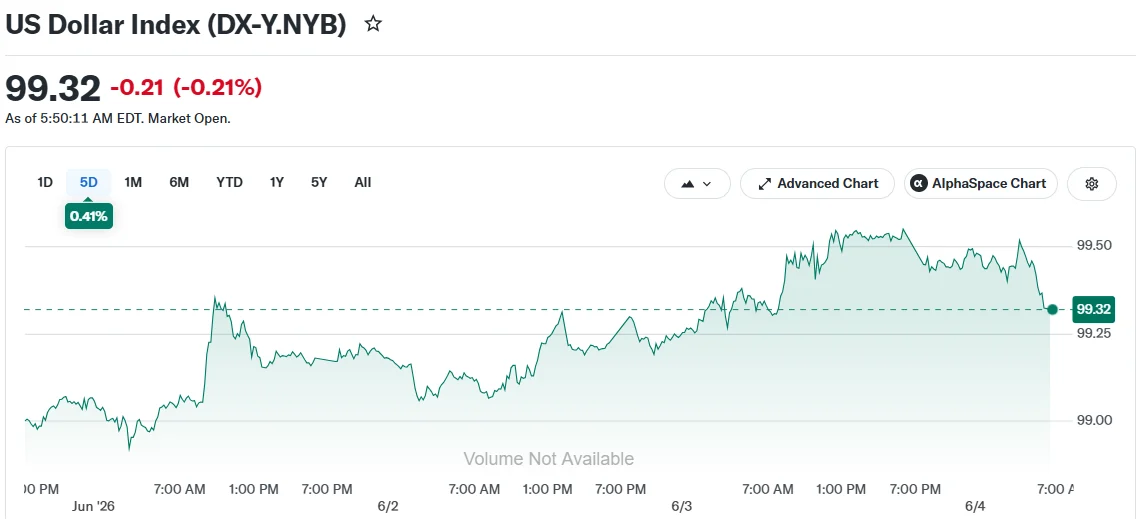
- The greenback maintained its position near a two-month peak fueled by escalating Middle East conflict and robust US economic indicators
- Missile strikes from Iran targeting Kuwait and American military operations near the Strait of Hormuz threatened an already unstable ceasefire
- Japan’s yen remained close to the 160 threshold against the dollar, a critical level that may prompt official intervention
- Bitcoin declined 2.8% to reach $63,119 while Ether dropped to a four-month bottom at $1,786
- Traders are closely watching Friday’s US employment report for insights into Federal Reserve monetary policy direction
The US dollar maintained its position near the strongest level witnessed in two months on Thursday as renewed hostilities in the Gulf region elevated crude oil prices and dampened enthusiasm for higher-risk investments. Bitcoin and Ether both slid to their lowest points in four months as market participants shifted toward more defensive positions.
Middle East Conflict Boosts Dollar Demand
Missile attacks launched by Iran against Kuwait inflicted damage on the nation’s airport and wounded dozens of people on Wednesday. Simultaneously, US military forces conducted operations in the vicinity of the Strait of Hormuz. These developments placed additional strain on an already fragile ceasefire agreement and generated uncertainty throughout international financial markets.
US officials announced that Israel and Lebanon had reached a consensus to move forward with a ceasefire arrangement, though implementation hinges on Hezbollah ending its military activities. However, continued attacks in other areas maintained a sense of caution among market participants.
The US Dollar Index climbed to 99.47, marking its most elevated reading since April 7. The euro remained relatively unchanged at $1.1604 while the British pound traded at $1.3424, with both currencies showing minimal movement.
“The safe haven appeal of the USD appears to be gaining momentum once more,” noted Sim Moh Siong, currency strategist at OCBC. He further stated there is “no compelling argument for USD weakness” and anticipates the dollar will remain resilient though trading within established ranges.
Robust economic data from the United States provided additional support. Employment services firm ADP indicated that businesses added 122,000 positions in May. The ISM services sector index climbed to 54.5 from the previous month’s reading of 53.6. Notably, the prices-paid metric within that survey surged to its most elevated level in nearly four years.
These inflation figures strengthened the conviction that the Federal Reserve will maintain current interest rate levels well into the following year. Market participants reduced their expectations for any imminent rate reductions.
Attention now shifts to Friday’s comprehensive employment report for additional clarity on Federal Reserve policy intentions.

Japanese Yen Approaches Critical Threshold
The Japanese yen traded at 159.91 against the dollar, remaining just beneath the psychologically significant 160 level that market observers widely regard as a potential catalyst for official currency market intervention. The yen momentarily breached the 160 mark on Wednesday, eliciting verbal cautions from Japanese government officials.
Bank of Japan Governor Kazuo Ueda indicated that monetary policymakers would need to weigh raising interest rates should inflation concerns outweigh potential economic downside risks. Researchers at Barclays characterized the commentary as sufficiently hawkish to justify a rate increase at the upcoming June policy meeting.
Analysts at ING observed that June historically represents a challenging period for the yen and predicted that market participants will continue to test higher levels in the dollar-yen currency pair.
Digital Asset Markets Under Pressure
Bitcoin declined 2.8% to settle at $63,119, reaching a four-month nadir. Ether tumbled to $1,786, similarly marking its weakest position in four months. Risk-averse sentiment sparked by geopolitical uncertainty pressured cryptocurrencies alongside other speculative investment categories.
The Australian dollar remained stable at $0.7132 while the New Zealand dollar advanced 0.2% to $0.5872, recovering from a one-week low point.
Get 3 Free Stock Ebooks
Discover top-performing stocks in AI, Crypto, and Technology with expert analysis.
- Top 10 AI Stocks - Leading AI companies
- Top 10 Crypto Stocks - Blockchain leaders
- Top 10 Tech Stocks - Tech giants


