


Key Highlights
- Volvo’s Q2 2026 adjusted operating income reached SEK 14.78 billion, representing a gain from SEK 13.48 billion in the prior-year period.
- The company’s adjusted operating margin expanded to 11.7%, compared to 11% in the second quarter of 2025.
- Order intake for trucks jumped 33%, with North American demand more than doubling compared to last year.
- U.S. tariff expenses totaled SEK 1.2 billion during the quarter, though this was balanced by enhanced services revenue and improved market positioning.
- The company submitted an IEEPA tariff refund application, anticipated to neutralize an expected SEK 1.1 billion tariff burden in the third quarter.
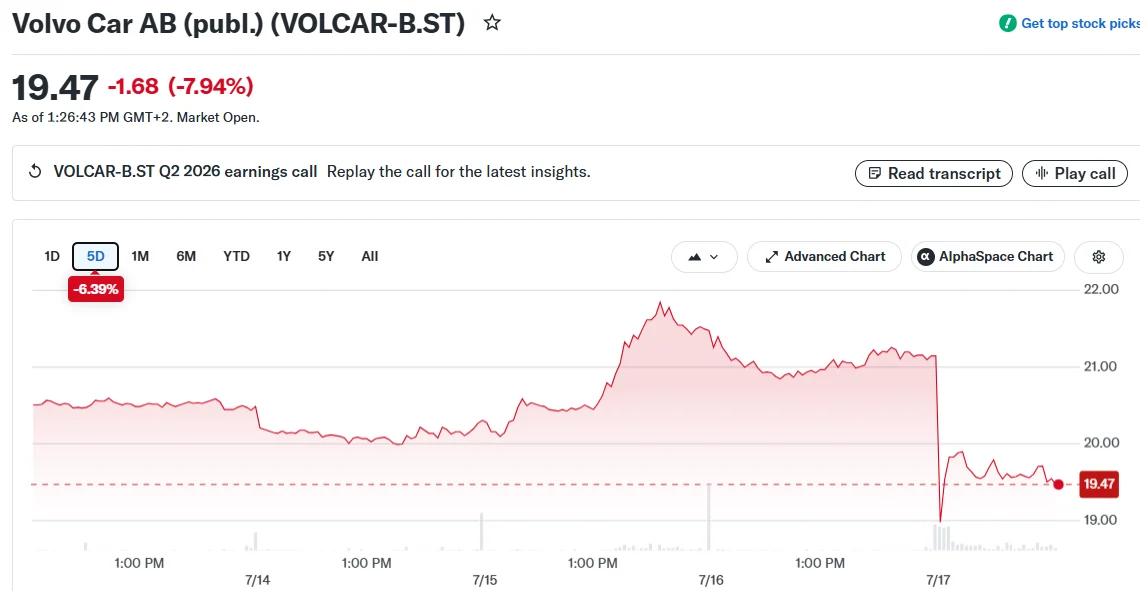
Volvo Group delivered a robust performance in its second quarter, demonstrating profitability growth and margin improvement even as tariff expenses mounted. The Swedish commercial vehicle manufacturer’s VOLVb shares traded near SEK 338.20, declining 0.91% during the session, despite fundamentals pointing to operational strength.
The company’s adjusted operating income registered at SEK 14.78 billion, marking an increase from SEK 13.48 billion recorded during the comparable quarter last year. The adjusted operating margin progressed to 11.7% versus 11%.
Revenue climbed 3% to SEK 126.27 billion, featuring organic expansion of 7%. Vehicle revenue experienced 6% organic growth while service revenue advanced 7%.
Reported operating income climbed to SEK 13.48 billion from SEK 9.96 billion, with the reported margin advancing to 10.7% from 8.1% in the previous year.
Earnings per share stood at SEK 5.10, versus SEK 3.64 in the year-ago period. Operating cash flow from Industrial Operations increased to SEK 5.84 billion compared to SEK 2.95 billion.

Return on capital employed achieved 26.8%, demonstrating robust capital productivity throughout the organization.
Dramatic Acceleration in Truck Demand
The demand environment proved exceptionally favorable for the truck business. Net orders surged 33% to 63,412 units. North American orders more than doubled on a year-over-year basis, while European and South American markets showed steady recovery.
Total truck shipments increased 6%. The Trucks division generated net sales of SEK 86.85 billion, up 6%, while its adjusted operating margin climbed to 11.2% from 10.3%.
CEO Martin Lundstedt noted the margin gains occurred despite challenges from U.S. tariffs and elevated freight and material expenses, which were successfully countered by robust service operations, advantageous brand and regional mix, and reduced research and development spending.
“Profitability reached its highest level in recent quarters,” Lundstedt added.
Tariff Challenges Mitigated — Temporarily
The net impact from U.S. tariffs amounted to a negative SEK 1.2 billion in Q2, with more than half affecting the Construction Equipment division. This represents a significant increase from the SEK 0.2 billion tariff burden in the prior year.
Construction Equipment revenue decreased 6% to SEK 21.60 billion, partially attributed to the SDLG divestiture, although organic sales expanded 13%. Its adjusted operating margin improved to 14.4% from 13.1%.
Buses revenue remained essentially unchanged at SEK 6.07 billion, with the adjusted margin rising modestly to 8.2% from 7.9%.
Volvo Penta represented the singular weak area. Revenue stayed relatively flat at SEK 5.43 billion, though its adjusted operating margin contracted to 16.7% from 20.7%, reflecting reduced volumes and elevated costs.
Following quarter-end, Volvo Group submitted a tariff refund application under the International Emergency Economic Powers Act. Management indicated it anticipates the refund will be recorded in Q3 2026 and will counterbalance a projected SEK 1.1 billion adverse tariff effect on operating income.
Get 3 Free Stock Ebooks
Discover top-performing stocks in AI, Crypto, and Technology with expert analysis.
- Top 10 AI Stocks - Leading AI companies
- Top 10 Crypto Stocks - Blockchain leaders
- Top 10 Tech Stocks - Tech giants


