



Key Highlights
- ZEC surged over 12% on Tuesday, touching $500 for the first time since early June
- Project Tachyon approaches completion of mathematical verification proving Ironwood’s shielded pool contains zero undetectable counterfeiting vulnerabilities
- Ironwood deployment planned for this month featuring a “turnstile” transition system
- Artificial intelligence has accelerated proof verification from years-long processes to mere weeks
- Market observers focus on $480–$500 as critical support zone, eyeing $530 as next resistance level
Zcash (ZEC) posted impressive gains exceeding 12% during Tuesday’s session, momentarily crossing back above the $500 threshold—a level unseen since the beginning of June. The price action followed a significant development update regarding Project Tachyon, an initiative aimed at providing mathematical verification that the forthcoming Ironwood shielded pool is completely secure from counterfeiting vulnerabilities.
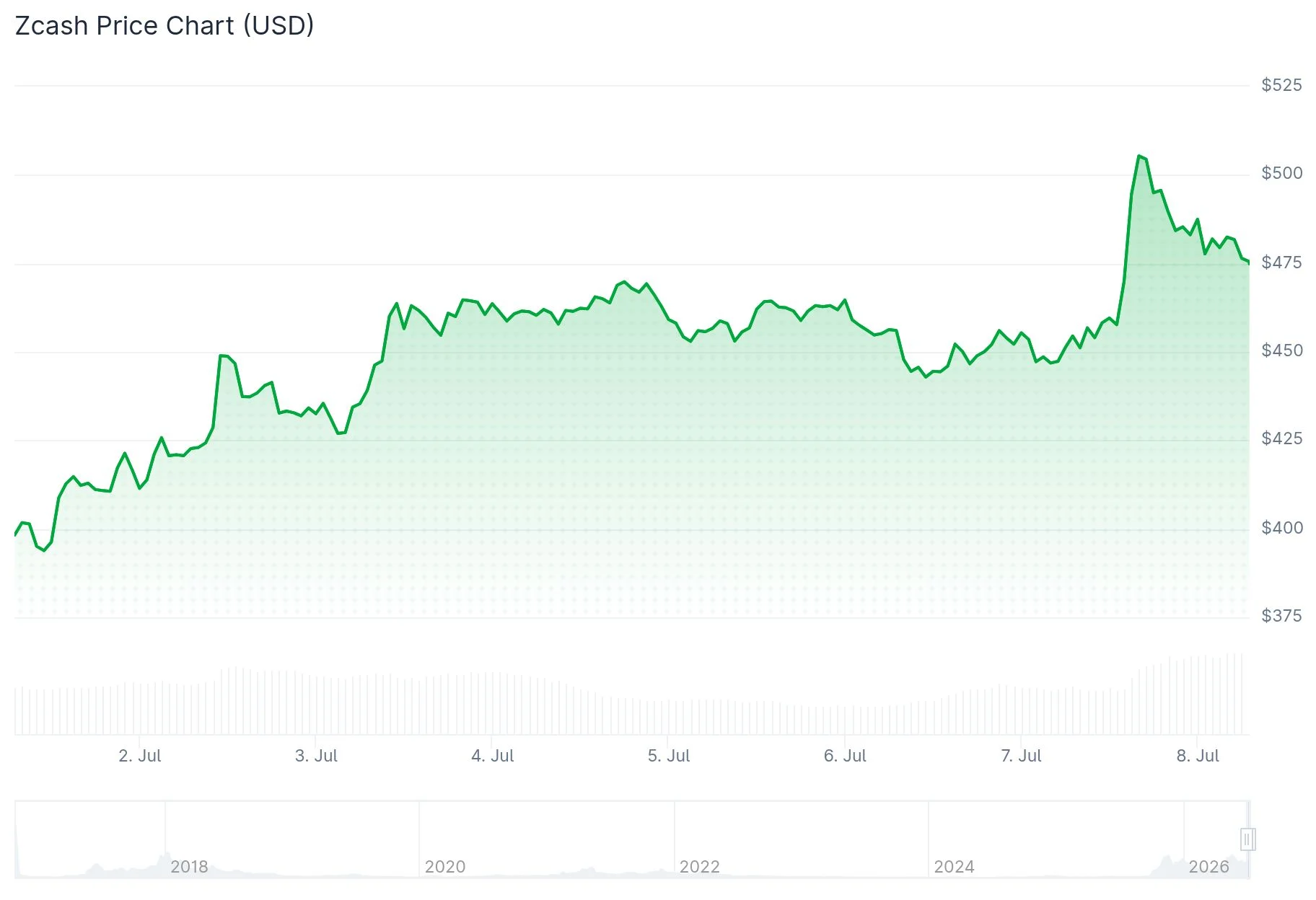
As of press time, ZEC was changing hands near $496.
The rally proved particularly noteworthy given Bitcoin’s stagnant price action during the same trading period. ZEC emerged as among the top-performing alternative cryptocurrencies, effectively breaking away from the otherwise lackluster market performance.
Understanding Project Tachyon
Zcash creator Zooko Wilcox announced the initiative is “on the verge of producing a mathematical proof that there are no undetectable counterfeiting bugs in the latest Zcash shielded pools.”
The significance of this development stems directly from last month’s security incident. Developers discovered a vulnerability within Zcash’s Orchard shielded pool that theoretically allowed malicious actors to mint fraudulent ZEC tokens without detection. The development team quickly implemented a patch and maintained no evidence suggested actual exploitation—however, the privacy-preserving architecture of Zcash made absolute confirmation impossible. News of this vulnerability triggered a steep 40% price decline across just two days.

Ironwood represents Zcash’s solution to replace the compromised Orchard pool. The upgrade incorporates a “turnstile” transfer mechanism enabling users to migrate holdings from Orchard while simultaneously generating verifiable proof that no hidden inflation transpired.
Former NEAR Protocol developer Vadim Zacodil drew parallels to Bitcoin’s 2010 inflation vulnerability, when 184 billion counterfeit bitcoins were momentarily generated. Bitcoin’s transparent blockchain immediately exposed the exploit. Zcash’s privacy-focused transaction architecture operates differently, creating the necessity for formal mathematical verification.
Project Tachyon revealed that artificial intelligence-enhanced proof generation has dramatically expedited this verification process—transforming what historically required years of work into a matter of weeks.
Key Technical Price Levels Under Scrutiny
Crypto analyst ZoneCrypto observed that ZEC successfully breached its 30-day exponential moving average positioned around $448 and recovered the 23.6% Fibonacci retracement level near $498, indicating strengthening market momentum.
Analyst Ardi identified a complex resistance cluster around $480, where a downward-sloping trendline intersected with horizontal price resistance. He suggested that multiple failed attempts to break this level created accumulation that eventually fueled the breakout. According to his analysis, sustained trading above $480 establishes a trajectory toward the lower $530 range.
Analyst ChiefraF drew attention to an extended trendline originating in February that has provided reliable support through several corrections. He referenced the prior rebound from this support level, which propelled ZEC from approximately $360 to $730.
Ironwood’s activation is slated for deployment within this month. Market participants are now closely monitoring for confirmation of the precise launch date as the next pivotal catalyst.
Get 3 Free Stock Ebooks
Discover top-performing stocks in AI, Crypto, and Technology with expert analysis.
- Top 10 AI Stocks - Leading AI companies
- Top 10 Crypto Stocks - Blockchain leaders
- Top 10 Tech Stocks - Tech giants


