



Key Points
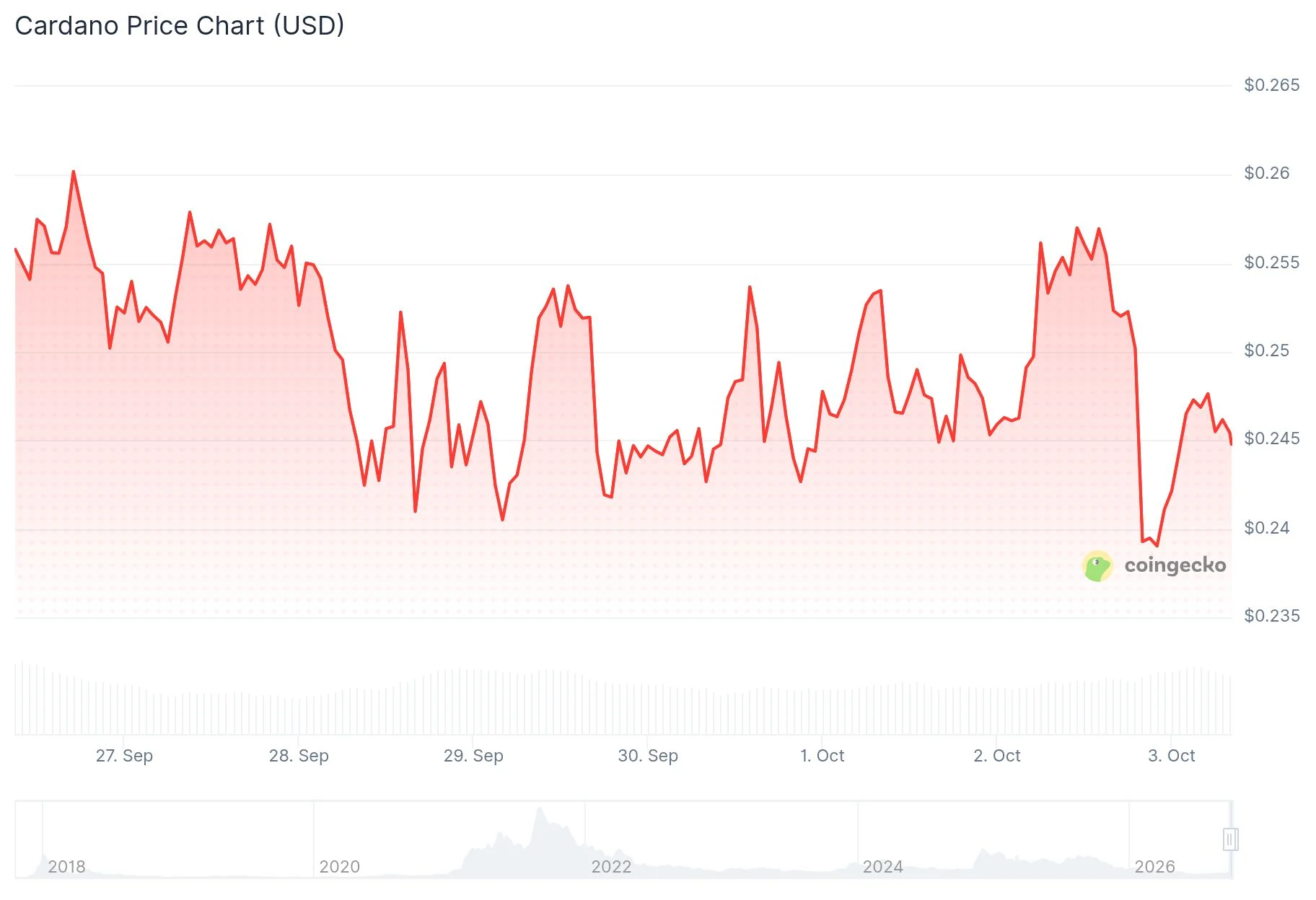
- Cardano (ADA) maintained a price around $0.2529, reflecting a 30% gain throughout the previous month.
- On October 1, the network processed 43,181 transactions, representing a 29% increase from the previous day’s volume.
- The token continues to trade above its $0.25 support zone, with $0.26 serving as the next barrier.
- Market analyst Lana Valentis highlighted nine years of ecosystem development and outlined price objectives reaching $3.10.
- Historical data shows ADA’s October performance has yielded an average return of -0.65%.
On October 2, Cardano’s price remained stable around $0.2529, following a robust 30% appreciation over the preceding 30 days. Throughout the most recent session, the digital asset maintained its position above the crucial $0.25 threshold.
On-chain metrics demonstrated increased engagement. The Cardano blockchain recorded 43,181 transactions on October 1, establishing the second consecutive daily peak for the current week.
This volume represented a 29% surge compared to September 30’s count of 33,467 transactions. Combined, these two consecutive days generated a total of 76,648 transactions across the network.
The blockchain’s daily average for 2026 hovers near 25,000 transactions. The October 1 figure exceeded this benchmark by approximately 73%.
During the seven-day period from September 24 through September 30, the network handled approximately 190,000 total transactions. Throughout that stretch, daily activity demonstrated consistent growth, advancing 43% from an initial 23,400 to conclude at 33,467 transactions.

Price Action and Key Chart Levels
As of October 2, ADA was changing hands at $0.2529, posting a 0.36% gain on the four-hour timeframe. Bulls need to push through the $0.26 resistance level to establish further momentum.
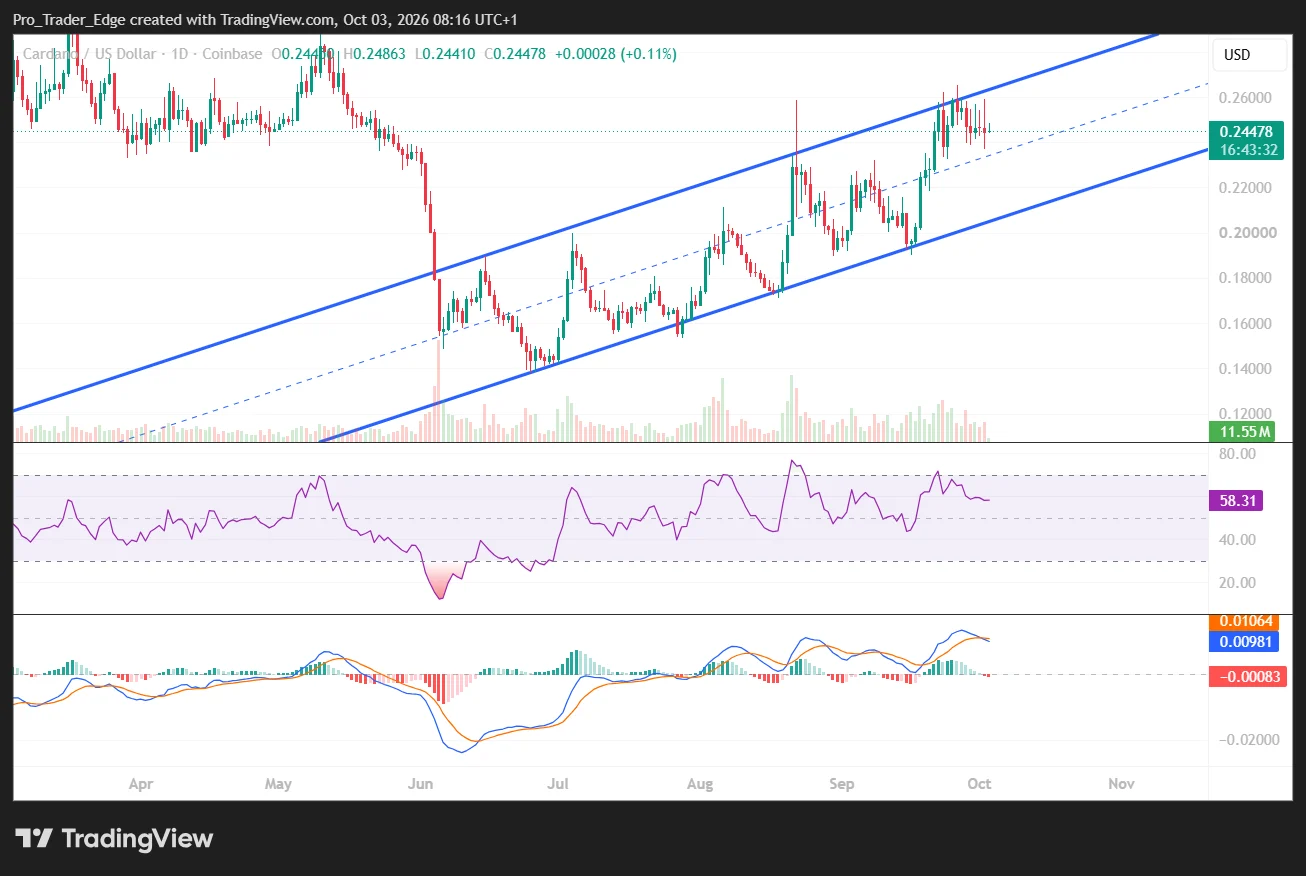
Should a four-hour candle settle above that ceiling, the path toward $0.27 would become the subsequent objective. Conversely, a breakdown beneath current support would likely test the $0.24 zone, which has historically attracted buying interest.
The four-hour Relative Strength Index registered 55.01, indicating moderate bullish momentum without entering overbought territory. The MACD indicator showed a reading of 0.0012, positioned above its signal line at 0.0004, accompanied by a positive histogram value of 0.0008.
September 2026 also marked nine years of continuous development for the Cardano ecosystem. Analyst Lana Valentis commemorated this achievement with an extensive review of the platform’s evolution.
Through a post on X, Valentis noted that Cardano has accumulated 123.9 million transactions since inception, established a foundation of 2,890 active stake pools, and completed 158 governance actions. She observed that the token had penetrated and secured a weekly close above a significant resistance band around $0.24, suggesting the possibility of a breakout scenario.
Valentis proceeded to outline multiple upside projections: $0.32, $0.50, $0.80, $1.20, and ultimately $3.10. The $3.10 target corresponds to ADA’s historical peak, which was established in September 2021.
Mathematical Path to Previous Peak
Ascending to $3.10 from present levels would necessitate a 1,117% rally. Given the current circulation of 36.78 billion ADA tokens, achieving that price point would push Cardano’s market capitalization to approximately $114 billion.
Valentis refrained from specifying when the token might achieve that valuation. Her technical chart illustrates ADA’s recovery from a low around $0.14 recorded earlier in 2026, with the asset now working to break above a prolonged descending trendline.
During the period of her assessment, ADA had advanced 4% across 24 hours and approximately 0.9% over the seven-day window. On a month-to-date basis, the token had accumulated gains of roughly 3.91%.
Charles Hoskinson, who founded Cardano, responded to recent community concerns regarding ADA’s price trajectory. He clarified that he maintains no formal responsibility for promoting adoption, emphasizing that the network functions through decentralized governance.
ADA’s historical October performance presents a varied picture. The asset delivered positive returns in 2017, 2019, and 2023, recording increases of 40.4%, 6.63%, and 15.4% during those years.
Conversely, it experienced declines in 2018, 2020, 2021, 2022, 2024, and 2025, with drawdowns spanning from 6.65% to 24.5%. When averaged across all available years, ADA’s October performance yields a -0.65% return, with a median figure of -6.95%.
Get 3 Free Stock Ebooks
Discover top-performing stocks in AI, Crypto, and Technology with expert analysis.
- Top 10 AI Stocks - Leading AI companies
- Top 10 Crypto Stocks - Blockchain leaders
- Top 10 Tech Stocks - Tech giants


