


Key Takeaways
- Spot gold surged past the $4,400 threshold Thursday, advancing 0.9% to reach $4,429.23 per ounce
- Declining US dollar strength and retreating Treasury yields fueled the precious metal’s recovery
- New York Fed President John Williams indicated ongoing disinflationary trends
- August ADP employment report showed a modest 38,000 job additions, dampening aggressive tightening concerns
- Market participants now await Friday’s critical nonfarm payrolls data release
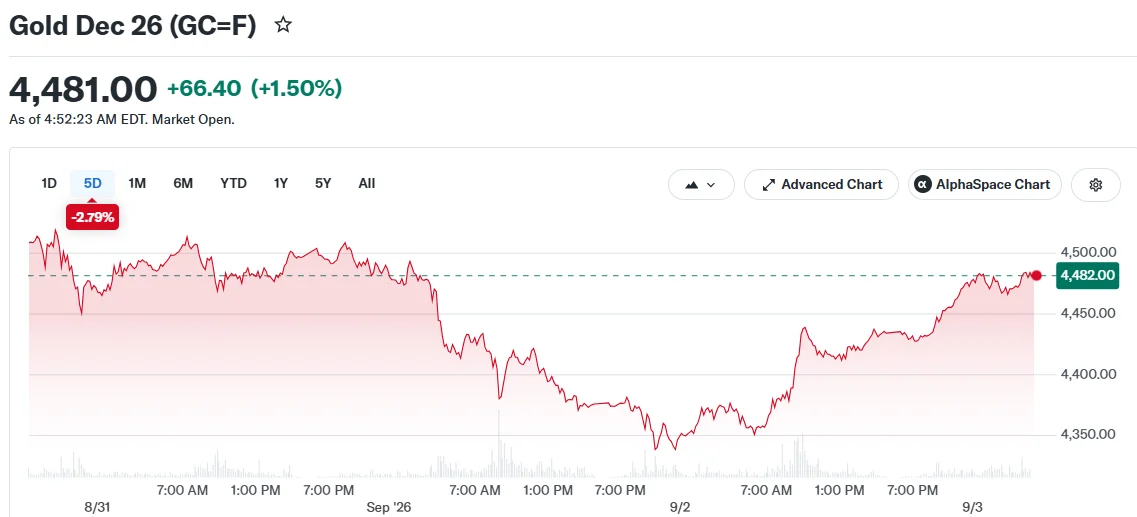
Gold prices surged beyond the $4,400 per ounce level Thursday, continuing a recovery that gained traction during the prior trading session. Spot prices advanced 0.9% to settle at $4,429.23, while futures contracts jumped 1.4% to reach $4,474.75.
This upward momentum materialized as the US Dollar Index declined 0.2% to 99.39. When the greenback weakens, it generally provides tailwinds for gold since international buyers find the precious metal more affordable in their local currencies.
Simultaneously, Treasury yields retreated from elevated levels seen in recent sessions. When bond yields decline, they diminish the attractiveness of income-producing investments, thereby enhancing gold’s relative appeal.
Other precious metals participated in Thursday’s rally as well. Silver spot prices climbed 0.6% to $65.75 per ounce, while platinum advanced 0.8% to $1,774.92.
Central Bank Commentary and Employment Figures Ease Tightening Concerns
John Williams, President of the Federal Reserve Bank of New York, indicated that evidence suggests US inflation continues its moderating trend as tariff impacts diminish. He noted that elevated energy costs have not cascaded into other service sectors.

Williams’ remarks represented a notably more dovish stance compared to the messaging from Fed Chair Kevin Warsh, whose hawkish Jackson Hole address last Friday had amplified market expectations for monetary tightening at the upcoming policy meeting in approximately two weeks.
Fresh employment statistics reinforced the more accommodative outlook. The ADP employment report revealed US companies added merely 38,000 positions in August. This deceleration in hiring activity reduced expectations for forceful Federal Reserve rate increases.
Rising interest rates typically pressure gold negatively since the metal produces no yield. As rates climb, investors find bonds and other interest-bearing instruments increasingly attractive alternatives.
Geopolitical Developments and Energy Market Dynamics
Gold had briefly touched its lowest point in nearly four weeks Wednesday before staging its recovery. Pressure on the metal partially stemmed from inflation concerns tied to crude oil price movements following renewed US military action against Iran.
President Trump suggested these strikes would probably be limited in duration. His statement helped moderate oil’s recent upward trajectory and alleviated some inflation anxieties that had been constraining gold prices.
Prolonged interruptions to global energy supplies could drive crude prices significantly higher, intensifying broader inflationary pressures. Such a scenario might compel the Federal Reserve to maintain a restrictive monetary policy stance, creating headwinds for gold.
The Japanese yen’s substantial appreciation also influenced markets, reigniting speculation about currency market intervention and contributing to Wednesday’s dollar weakness.
Market Outlook and Upcoming Catalysts
Market attention now centers squarely on Friday’s August nonfarm payrolls release. Disappointing employment figures could further diminish rate increase expectations and propel gold’s rebound higher.
Conversely, robust job growth data might reignite Treasury yield increases and limit gold’s upside potential, according to analyst Joseph Dahrieh from Tickmill. Spot gold was last quoted 0.7% higher at $4,423.17 per ounce.
Notwithstanding the recent recovery, some market observers caution that gold remains vulnerable to downside pressure should the employment data exceed expectations.
Get 3 Free Stock Ebooks
Discover top-performing stocks in AI, Crypto, and Technology with expert analysis.
- Top 10 AI Stocks - Leading AI companies
- Top 10 Crypto Stocks - Blockchain leaders
- Top 10 Tech Stocks - Tech giants


