


Key Highlights
- Soitec shares rallied up to 15.1% following an upward revision of its Q2 fiscal 2027 revenue growth outlook to approximately 50% year-over-year, upgraded from 30%.
- The revision stems from rapidly increasing demand for Photonics-SOI substrates deployed in optical networking for AI data centres.
- The company anticipates Q2’27 Photonics-SOI sales will reach approximately triple the Q2’26 figure of about $25 million.
- Soitec is securing customers through multi-year capacity reservation contracts featuring deposits and predetermined pricing structures.
- The firm commands an approximate 95% share of the silicon photonics substrate market and doesn’t anticipate requiring additional factory capacity until approximately 2029.
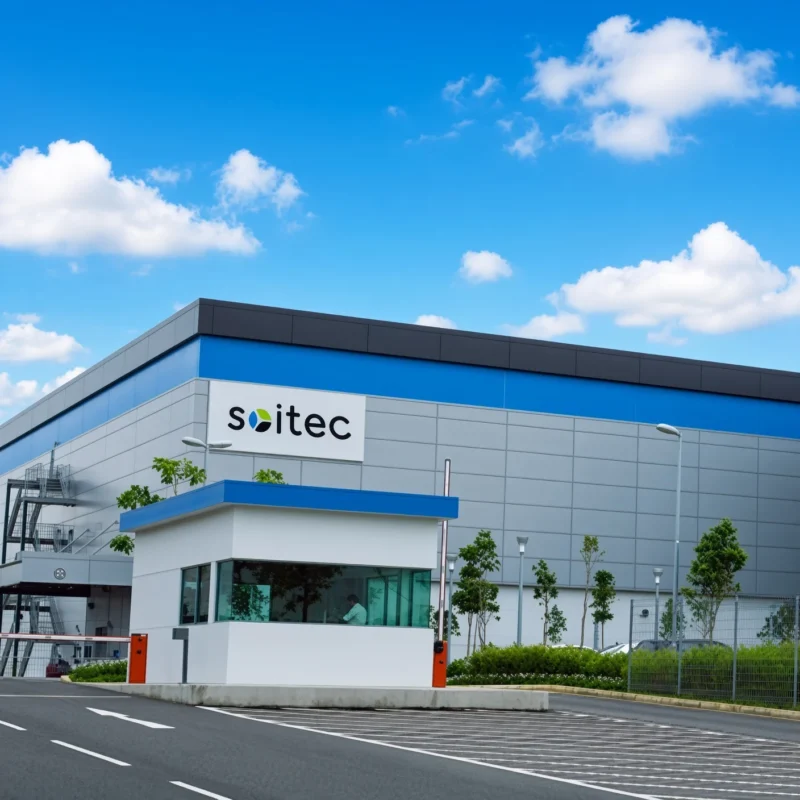
Soitec stock climbed as high as 15.1% on Thursday following the French semiconductor materials company’s announcement that it was elevating its second-quarter revenue growth projection to roughly 50% year-over-year at constant exchange rates, a substantial increase from the previous guidance exceeding 30%.
According to the company, this enhanced outlook is attributed to intensifying demand for its Photonics-SOI wafer products, improved clarity on imminent customer requirements, and the organization’s capability to rapidly modify production capacity.
The firm now projects Photonics-SOI sales in Q2 fiscal 2027 will reach approximately three times the Q2’26 amount of around $25 million. Looking at the first-half performance, Soitec expects fiscal 2027 revenues to be roughly 2.3 times the first-half fiscal 2026 total of about $50 million.
For the complete fiscal year 2027, the company’s guidance places Photonics-SOI revenue between 2.5 and 3 times the fiscal 2026 baseline, which stood slightly above $100 million. CEO Laurent Remont has now characterized this $200 million-plus projection as “absolutely a floor,” rather than an upper limit.

The company’s remaining business segments show relatively stable performance. Soitec recorded approximately €600 million in aggregate revenue during fiscal 2025-2026.
Securing Long-Term Customer Commitments
Soitec is taking proactive measures rather than remaining passive. The organization is actively executing multi-year Capacity Reservation Agreements with photonics clients, with roughly 80% of these contracts anticipated to be finalized within the next week or two.
These agreements mandate that customers provide deposits linked to their committed purchase volumes. When customers fulfill their contracted quantities, deposits are refunded. Failure to meet commitments results in deposit forfeiture. Demand exceeding agreed-upon levels triggers renewed pricing negotiations.
“That’s a way for us to have our customer with skin in the game,” Remont told Reuters.
Additionally, customers must provide inventory information, a strategy intended to prevent excessive ordering aimed at monopolizing supply away from rival firms.
Soitec anticipates finalizing agreements with eight of approximately 10 principal customers in the upcoming weeks.
Production Expansion Strategy and Factory Timeline
Silicon photonics demand has experienced dramatic growth as cloud hyperscalers transition toward optical connectivity within AI infrastructure, where traditional copper connections are becoming less competitive regarding power efficiency and performance metrics.
Soitec provides the substrate foundation for virtually all silicon photonics semiconductors. UBS analysts place its market dominance at approximately 95%. The company’s shares have nearly quadrupled in value this year.
The organization doesn’t foresee requiring a new manufacturing facility until roughly 2029. Meanwhile, it’s employing two strategies: reallocating production between business segments utilizing shared infrastructure, and installing additional equipment within current cleanroom facilities.
Until five months ago, Soitec manufactured Photonics-SOI exclusively in France. Since then, it has certified a Singapore-based facility.
A third possibility involves equipping an empty building in Singapore rather than constructing an entirely new fabrication plant. A determination on this approach is anticipated within six to 12 months.
Remont stated there’s no requirement for a U.S.-based manufacturing plant “at this stage,” noting that customers are “more desperate to get wafers than being too picky about where the location for production is.”
Get 3 Free Stock Ebooks
Discover top-performing stocks in AI, Crypto, and Technology with expert analysis.
- Top 10 AI Stocks - Leading AI companies
- Top 10 Crypto Stocks - Blockchain leaders
- Top 10 Tech Stocks - Tech giants


