



Key Takeaways
- The network processed over $15 billion in token migrations through its CCIP infrastructure throughout 2026.
- The second iteration of CCIP launched during Q3, introducing enhanced security features and institutional-grade controls.
- Partnerships broadened to include Swift banking network, DTCC operations, and government-backed initiatives in Wyoming and Hong Kong.
- On October 22, LINK changed hands at $12.24, representing a decline from the $15.70 level reached earlier in the month.
- Technical indicators show RSI at 44.11 with bearish MACD signals, establishing $12 as critical support and $13 as immediate resistance.
The LINK token hovered around $12.24 on October 22, reflecting a pullback from the approximately $15.70 peak observed in mid-October. This price movement followed the publication of the network’s quarterly performance summary.
According to the release, Chainlink’s Cross-Chain Interoperability Protocol (CCIP) facilitated more than $15 billion worth of token transfers during 2026. The document highlighted fresh collaborations with the Swift financial messaging system and the Depository Trust & Clearing Corporation (DTCC).
The third quarter saw the activation of CCIP 2.0, which introduced enhanced security protocols, regulatory compliance tools, and settlement mechanisms designed for financial institutions transferring digital assets across different blockchain networks.
Organizations including BitGo and the Wyoming Stable Token Commission migrated their assets to the platform. Existing users Aave, Coinbase, and xStocks expanded their protocol integration, while Nethermind initiated the transition of its operational infrastructure to Chainlink systems.
Following a comprehensive security audit, Wyoming transferred its FRNT stablecoin to CCIP in August. The commission designated Chainlink as the exclusive cross-chain solution provider for FRNT under a long-term agreement.

The network reported that CCIP now protects over $85 billion in cross-chain token assets. Total transaction value facilitated by its infrastructure surpassed $36 trillion, though this metric does not reflect direct revenue generation.
Banking Sector Integrations and Public Sector Adoption
During the Sibos banking conference, Chainlink unveiled Fulcrum, a platform designed to facilitate securities financing and collateral administration across both public and permissioned blockchain systems.
The company also introduced a solution enabling financial institutions to interface with Swift’s blockchain ledger through its Chainlink Runtime Environment (CRE). This approach allows banks to maintain direct control over their cryptographic signing keys.
DTCC’s Collateral AppChain plans to leverage CRE alongside Chainlink data infrastructure for managing collateral operations. The quarterly review documented a proof-of-concept transaction where JPMorgan utilized tokenized equity securities as margin collateral with CME Group.
Wyoming implemented Chainlink Proof of Reserve in September to broadcast reserve information for FRNT across multiple blockchain networks. Hong Kong’s Tokenized Securities Framework incorporated CCIP and Chainlink’s Automated Compliance Engine into its technical architecture.
The Bank of England’s Synchronisation Lab demonstrated CRE orchestrating settlement between central bank digital currency and tokenized financial instruments. Polymarket, World, and LBank integrated Chainlink infrastructure for market settlement and payment distribution.
During the third quarter, Chainlink’s Reserve accumulated 1,543,330.47 LINK tokens, elevating total reserves to 6,047,498.3150 LINK. The Smart Value Recapture mechanism surpassed $24.4 million in cumulative value recovery.
Technical Analysis Shows LINK Approaching Critical Zone
LINK declined approximately 0.67% in the 24-hour period, based on crypto.news market data. The seven-day performance remained in positive territory at roughly 1.68%.
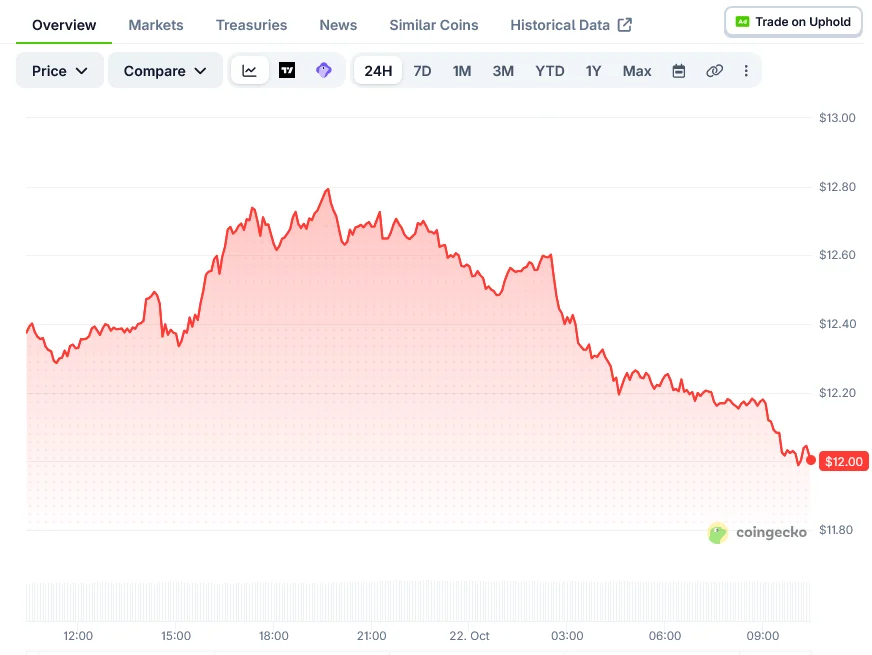
Chart analysis on TradingView shows LINK gravitating toward the $12 threshold after momentum weakened from the $15.70 peak. The Relative Strength Index registers 44.11, positioned below the neutral 50 mark but above oversold territory. The MACD indicator at -0.224 continues trading beneath its signal line at -0.121.
Market conditions currently favor sellers. A breach below $12 would expose the $11 level as the next defensive zone for buyers, whereas recovering $13 would bring $14 back into consideration. The $12 level represents the most significant near-term reference point for price action.
Get 3 Free Stock Ebooks
Discover top-performing stocks in AI, Crypto, and Technology with expert analysis.
- Top 10 AI Stocks - Leading AI companies
- Top 10 Crypto Stocks - Blockchain leaders
- Top 10 Tech Stocks - Tech giants


