



Key Takeaways
- Staked Ethereum reached an unprecedented 43.8 million ETH during Q3 2026, representing 35.9% of the entire circulating supply.
- Staking inflows added 1.99 million ETH to the network, marking the sixth consecutive quarter of expansion.
- Gross staking returns declined from 2.81% to 2.63% during the period.
- Validator numbers contracted from approximately 1.1 million to 881,000 following consolidation enabled by the Pectra upgrade.
- Bitwise data indicates Ethereum’s returns lag behind Solana (5.99%) and NEAR (4.87%) in the proof-of-stake landscape.
The third quarter of 2026 witnessed Ethereum staking reach a milestone of 43.8 million ETH. This figure represents 35.9% of the network’s entire token supply, according to findings published in Bitwise’s Q4 2026 Staking Report.
The achievement extends a streak of six consecutive quarters showing expansion in staked ETH holdings. During this same timeframe, network staking returns decreased to 2.63%.
Bitwise’s analysis documented net inflows of 1.99 million ETH throughout the quarter. These additions drove the cumulative staking total to its highest point on record.
A 35.9% staking ratio means more than a third of all existing ETH now serves to secure network operations. This locked ETH remains unavailable for standard trading or transfer activities.
The aggregate figure does not reveal distribution patterns among validator operators. It exclusively quantifies the total volume under lock.

Network Returns Decline While Validator Numbers Contract
Gross staking returns slipped from 2.81% to 2.63% across the quarter. Declining returns typically reduce the appeal for income-focused market participants.
Despite lower yields, inflows persisted. Certain participants stake for network security contributions or to access institutional investment vehicles.
Bitwise’s research also documented a validator decline from roughly 1.1 million to 881,000. This contraction occurred even as total staked ETH volumes increased.
The firm attributed the validator reduction to operators merging validators following Ethereum’s Pectra upgrade implementation. The upgrade simplified balance consolidation for qualifying validators.
According to Ethereum’s official staking documentation, Pectra introduced compounding validator credentials. These credentials enable eligible validators to accumulate rewards on balances exceeding 32 ETH, with a maximum of 2,048 ETH.
This modification can reduce operational expenses for large-scale staking operations. However, reduced validator entries do not necessarily indicate fewer independent operators, nor do they automatically enhance decentralization metrics.
Ethereum’s Position Among Competing Proof-of-Stake Networks
Bitwise’s comparative analysis placed Ethereum’s 2.63% yield below Solana’s 5.99% and NEAR’s 4.87%. These numbers do not serve as equivalent investment return indicators, given that each network operates under distinct tokenomics, validator requirements and risk characteristics.
The comparative data demonstrates Ethereum’s competition with alternative proof-of-stake protocols for staking capital. For ETH holders, the decision extends beyond simple yield comparisons.
Staking compensation is distributed in ETH. The dollar-denominated value fluctuates alongside the token’s market valuation.
Participants utilizing pooled or liquid staking platforms also encounter provider fees and withdrawal conditions. Ethereum’s official staking pool documentation notes that access to withdrawals and processing speed differ across providers.
Market observers continue monitoring staking inflows, validator concentration patterns and yield fluctuations. Bitwise’s analysis encompasses data through the conclusion of the third quarter.
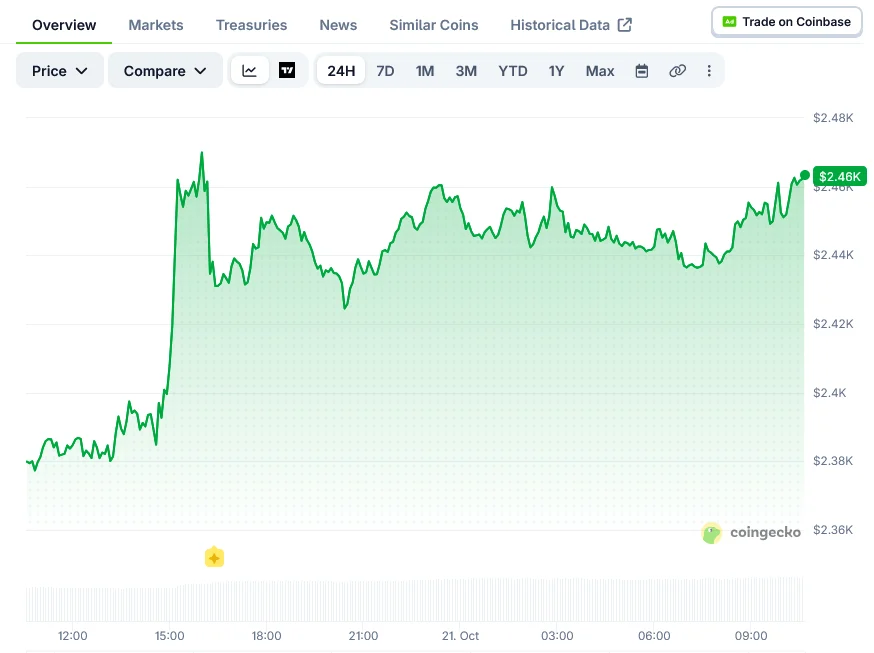
Ethereum’s market price has remained under $2,500, according to related coverage, as BitMine expanded its holdings by 12,535 ETH.
Get 3 Free Stock Ebooks
Discover top-performing stocks in AI, Crypto, and Technology with expert analysis.
- Top 10 AI Stocks - Leading AI companies
- Top 10 Crypto Stocks - Blockchain leaders
- Top 10 Tech Stocks - Tech giants


