


Key Takeaways
- Washington has levied 50% tariffs on approximately $20 billion in Canadian goods, prompting Ottawa to announce matching countermeasures effective September 8
- Ford and General Motors face direct impact as Canadian-manufactured heavy-duty pickups like the F-350 and Silverado risk losing preferential tariff status
- Canada provides 68% of American aluminum imports, setting up potential supply constraints that could benefit U.S. domestic aluminum producers
- Approximately 60% of American crude oil imports originate from Canada, exposing firms like Suncor and Imperial Oil to significant trade disruption
- Morgan Stanley analysts project potential tariff reduction from 50% to 25% on Canadian aluminum, though profitability headwinds would persist
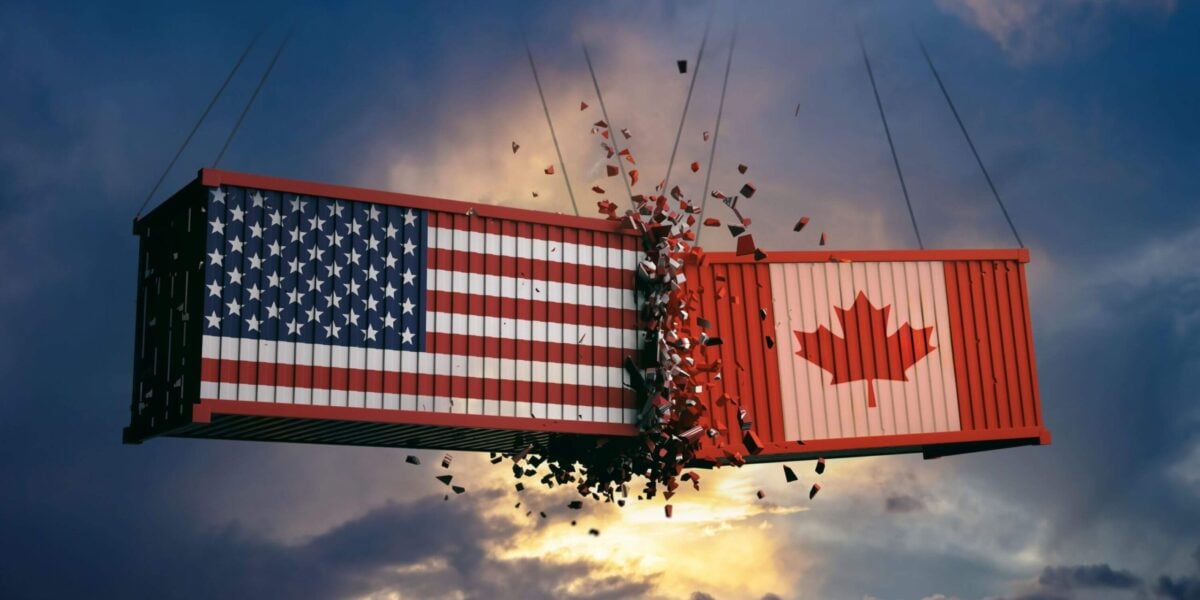
A major trade confrontation is brewing between the United States and Canada following Washington’s decision to impose 50% duties on roughly $20 billion in Canadian goods. The bilateral trade relationship encompasses approximately $780 billion annually, with intricate supply networks spanning automotive manufacturing, industrial metals, and petroleum sectors.
Canadian Prime Minister Mark Carney announced that Ottawa will respond with equivalent retaliatory measures beginning September 8, matching American tariffs on a “dollar for dollar” basis. Diplomatic negotiations between the neighboring nations broke down after a three-day negotiating session failed to produce agreement.
Automotive Manufacturers Face Escalating Challenges
[[LINK_START_0]]Ford[[LINK_END_0]] and [[LINK_START_1]]General Motors[[LINK_END_1]] find themselves at the center of this trade dispute. A critical breakdown point in the unsuccessful negotiations involved the classification of larger commercial vehicles.
Ottawa sought preferential duty treatment for medium- and heavy-duty pickup trucks. Washington declined that request. Consequently, Canadian-assembled Ford Super Duty models—including the F-350, F-450, and F-550—along with the GM Silverado heavy-duty variants may face higher costs or diminished market competitiveness in the United States.
Magna International, a major Canadian automotive components manufacturer, carries substantial exposure to this conflict. The corporation operates over 325 manufacturing sites throughout North America. While its shares have surged more than 40% year-to-date, an intensifying trade dispute could quickly erase those gains.
Automotive components frequently traverse the U.S.-Canada border as many as eight times during the production cycle before final vehicle assembly. This means tariffs compound with each crossing under the prevailing just-in-time production framework.

Canada’s retaliation package targets American steel, consumer electronics, household appliances, dairy products, farming machinery, and pulp and paper goods. Government officials indicated they will unveil support programs for impacted Canadian sectors in the coming week.
Mining and Petroleum Sectors Under Threat
Canadian aluminum represents 68% of total U.S. aluminum imports. During the first half of 2026, the United States imported 1.68 million tonnes, with Canadian sources providing 1.16 million tonnes of that volume.
Morgan Stanley’s research indicates that even if all Canadian aluminum shipments were diverted to American markets, it would satisfy only 95% of import requirements. Domestic U.S. producers such as Nucor stand to gain from sheltered pricing environments if Canadian supply flows are curtailed.
Teck Resources, a prominent Canadian mining company, confronts immediate tariff exposure on its aluminum and zinc shipments. Though its stock has climbed 45% year-to-date, sustained tariffs could squeeze profit margins.
In the energy arena, Canada furnishes roughly 60% of U.S. [[LINK_START_2]]crude oil imports[[LINK_END_2]]. Suncor Energy and Imperial Oil are both Canadian petroleum producers with substantial U.S. export dependence. Both equities have delivered impressive returns this year—gaining 56.5% and 61.6% respectively—yet trade restrictions could severely disrupt their primary export destination.
The critical deadline to monitor is September 8, when Canada’s countervailing tariffs are scheduled to commence. Whether bilateral discussions will resume before that date remains uncertain.
Get 3 Free Stock Ebooks
Discover top-performing stocks in AI, Crypto, and Technology with expert analysis.
- Top 10 AI Stocks - Leading AI companies
- Top 10 Crypto Stocks - Blockchain leaders
- Top 10 Tech Stocks - Tech giants


