


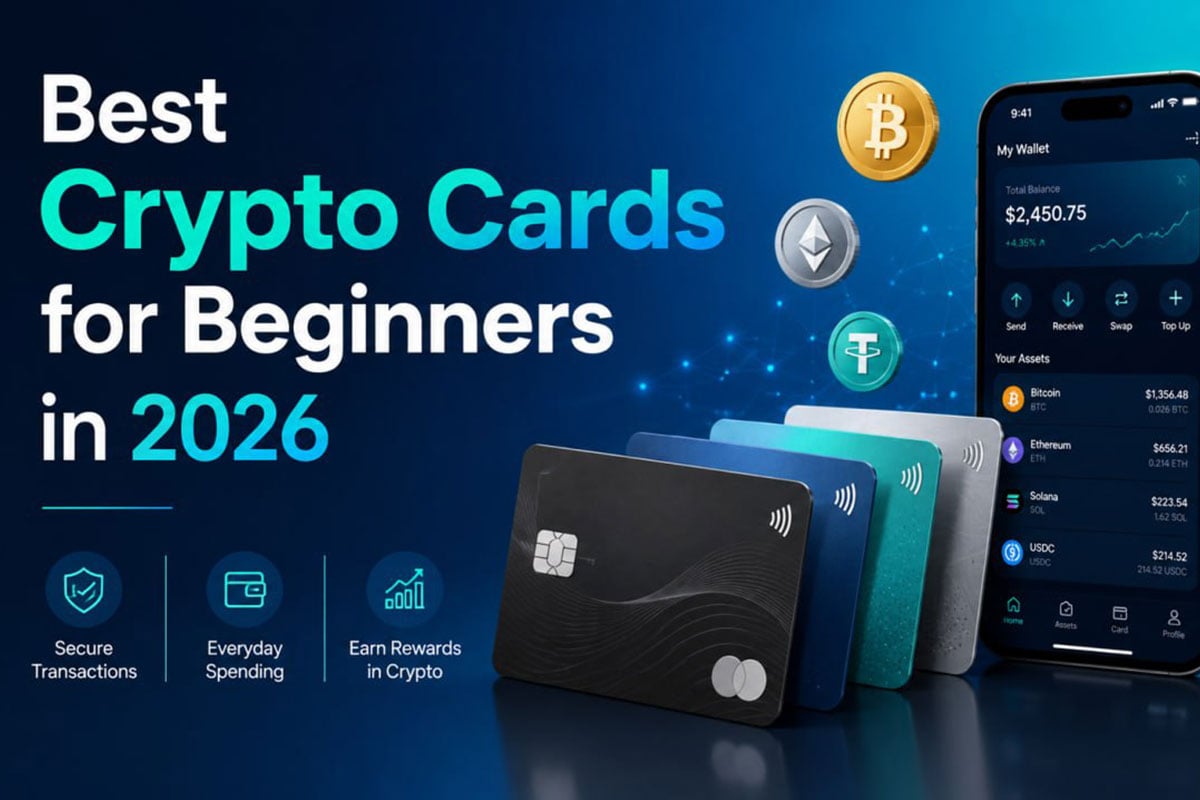
Quick Answer: Which Crypto Card Should a Beginner Choose in 2026?
There’s no single best crypto card for every beginner; eligibility, holdings, custody preferences, and local terms come first. Coinbase Card can be straightforward for eligible users, though U.S. and EU/UK programs differ. Crypto.com’s Prepaid Card suits beginners seeking an established app ecosystem and physical-card option, but rewards and Level Up requirements vary by jurisdiction.
MEXC Global Card (MEXC Card) is especially relevant to eligible USDT holders. It is currently a virtual Visa debit card; the physical card has not launched. It can also be added to supported Apple Pay and Google Pay wallets. Bitget Wallet Card better suits users who prioritize self-custody and can manage their own wallet security.
Key Takeaways
- Compare the realistic cost of spending after transaction, conversion, and FX charges rather than choosing the largest advertised reward.
- For beginners, prioritize eligibility, simple funding, understandable fees, custody/recovery, and mobile-wallet usability before VIP benefits.
- Rewards paid in volatile tokens can lose value after they are earned; stablecoin or fiat-denominated rewards have less price volatility.
- Custodial cards are generally easier to fund and recover, while self-custodial cards give users greater control but shift more wallet-security responsibility onto them.
- Check regional eligibility first. Card programs, fees, reward tiers, physical-card availability, and Apple Pay or Google Pay support can differ by country.
How We Ranked the Best Beginner Crypto Cards
We applied the same framework to each card: beginner usability (25%), fees and conversion costs (20%), everyday usability (20%), security and custody (15%), rewards without excessive complexity (10%), and supported assets/ecosystem (10%).
Country eligibility is assessed before scoring rather than included in the 20% usability score. A card cannot be a realistic recommendation for a reader who cannot apply for that regional card program.
Best Crypto Cards for Beginners in 2026, Compared
| Card | Best for | Custody | Card cost | Beginner reward | Main spending cost | Main limitation |
| MEXC Card | Eligible existing USDT holders | Custodial | $0 virtual issuance, annual fee, and top-up fee under current terms | 4% Standard, 6% Premier, 10% Elite; capped | Spending fee as low as 1%; no MEXC FX markup; Visa FX costs may apply | Advanced KYC; currently virtual only |
| Crypto.com Prepaid Card | Established app and physical-card ecosystem | Custodial | Basic access available without an ongoing card fee in applicable markets | Level Up rewards vary by plan and jurisdiction | FX, top-up, and other costs vary by regional program | Better rewards require Level Up participation |
| Coinbase Card | Eligible users wanting a simple custodial card | Custodial | No application fee; regional terms vary | U.S.: variable crypto rewards | No Coinbase transaction fee; crypto spread can apply | U.S. and EU/UK programs have different terms |
| Wirex Card | Low-entry-cost card with modest base rewards | Custodial | Current terms depend on Wirex program and region | X-tras documentation lists 0.5% WXT at Standard Entry | Regional card/FX rules apply | 2026 product transition; WXT price exposure |
| Bitget Wallet Card | Users prioritizing self-custody | Self-custodial | $0 opening and annual fee | 2% base Assetback; up to 3% Booster | Top-up/conversion conditions vary by market | User handles wallet recovery and private-key security |
| Bybit Card | Existing Bybit users | Custodial | Virtual issuance currently free in listed regional programs | Rewards Points equivalent to 2%–10% by tier | FX and crypto-conversion fees vary by issuing region | Regional programs differ substantially |
| RedotPay Card | Stablecoin-first spending | Custodial | $10 virtual / $100 physical | No general base cashback; Pro offers 3% on qualifying wallet payments | 1% crypto conversion; 1.2% non-card-currency transaction fee | Pro subscription needed for 3% cashback |
MEXC’s current tier structure is 4% Standard with a 100 USDT monthly cap, 6% Premier with a 300 USDT cap, and 10% Elite with an 800 USDT cap, subject to the applicable M-Score/VVIP tier. Bitget’s current Assetback program starts at 2% and can rise to 3% for new or qualifying users. Bybit’s issuer documentation confirms that both fees and limits differ substantially by card region.
Which Crypto Card Fits Your Situation?
- Eligible for a Coinbase regional program and want relatively few moving parts → Coinbase Card
- Want an established app with a physical-card option → Crypto.com Prepaid Card
- Already hold USDT and are eligible for the Global Card → MEXC Card
- Want a low-entry-cost card with modest base rewards → Wirex Card
- Keeping control of your crypto wallet matters most → Bitget Wallet Card
- Already use Bybit for trading or holding assets → Bybit Card
- Mostly hold stablecoins and want a dedicated payments app → RedotPay Card
Don’t switch platforms purely for a 5%–10% headline reward. A subscription, token commitment, FX charge, conversion cost, spending threshold, or monthly cap can materially change the effective value.

7 Crypto Cards for Beginners in 2026, Reviewed
1. MEXC Card
MEXC Card is a USDT-funded Visa debit card available to eligible users after Advanced KYC. It can be used for qualifying Visa purchases, subject to merchant, wallet, and geographic restrictions.
Current Global Card terms list 4% cashback for Standard, 6% for Premier, and 10% for Elite, capped monthly at 100, 300, and 800 USDT respectively. The 10% rate therefore is not a typical beginner reward.
The spending fee is as low as 1%. MEXC applies no exchange-rate markup, although Visa-related FX costs of roughly 0.1%–0.3% may apply.
The card is currently virtual only; no physical plastic card has launched. It supports eligible Apple Pay and Google Pay use. A separate 7% APR flexible earning product is also available to qualifying card users but is not part of cashback.
Strengths: good fit for existing USDT holders; $0 virtual issuance, annual, and top-up fees under current terms; stablecoin cashback; mobile-wallet support.
Limitations: Advanced KYC and geographic restrictions; no physical card yet; higher cashback requires greater account activity.
2. Crypto.com Prepaid Card
Crypto.com’s Prepaid Card offers beginners an established payments and rewards ecosystem. Its Level Up framework includes Basic, Plus, Pro, and Private plans, with card rewards available to qualifying users.
However, reward rates, CRO requirements, subscriptions, and benefits vary by jurisdiction. For example, eligible users in France, Germany, and Italy gained a BTC-or-CRO reward choice in June 2026, illustrating why a single global rewards table can be misleading.
Strengths: established virtual/physical-card ecosystem; strong app integration; upgrade path for active users.
Limitations: better rewards require Level Up participation; terms and costs vary by region.
3. Coinbase Card
Coinbase runs separate regional card programs, so U.S. terms should not be applied to EU or UK users. In the U.S., the debit card is available in every state except Hawaii and supports spending USD, USDC, or eligible crypto without a separate Coinbase card transaction fee, although crypto conversions may include a spread. Rewards are optional, variable, and currently specific to the U.S. program.
EU/UK users should check their local Coinbase Card page for applicable eligibility, fees, wallet support, and rewards.
Strengths: simple custodial funding; no token lock for basic use; familiar for Coinbase users.
Limitations: regional terms vary; crypto conversions may involve a spread; crypto spending can have tax consequences.
4. Wirex Card
Wirex requires extra caution because its 2026 materials reflect a product transition. Older X-tras documentation lists a free Standard Entry plan with 0.5% Cryptoback in WXT, while higher rewards involve subscriptions and/or WXT locks.
Newer marketing describes a five-tier structure with no subscription fee, so older X-tras pricing should not be mixed with newer program claims.
Strengths: low entry cost in supported programs; virtual and physical cards; documented base reward.
Limitations: WXT rewards carry token-price risk; current structure and regional availability should be verified in-app.
5. Bitget Wallet Card
Bitget Wallet Card is the strongest option here for users seeking a self-custody-oriented setup. Its Assetback program offers 2% on eligible spending, with 3% available to new or qualifying cardholders. Reward choices include Bitcoin, tokenized gold, selected tokenized U.S. stocks or ETFs, and USDC.
Bitget currently lists $0 opening and annual fees, Apple Pay and Google Pay support, and availability in more than 50 countries and regions, subject to issuing-partner restrictions.
Strengths: self-custody control; 2% base Assetback; multiple reward assets; broad wallet integration.
Limitations: users must manage recovery credentials and private-key security themselves.
6. Bybit Card
Bybit Card is most attractive to people already using Bybit. Its Rewards Points system corresponds to cashback from 2% at the base tier to 10% at the highest tier, with spending thresholds, VIP levels, and monthly caps affecting actual returns.
Fees are highly regional. Bybit maintains separate programs across markets including Australia, Asia Pacific, Argentina, Brazil, Georgia, Kazakhstan, Mexico, and Peru. A 0.9% crypto-conversion fee applies in several—but not all—regions, while FX and physical-card fees also differ. Virtual issuance is currently free in listed programs until further notice.
Strengths: convenient for existing Bybit users; free virtual issuance in current programs; strong potential rewards.
Limitations: highly region-dependent fees; headline cashback rates are not representative of typical beginner returns.
7. RedotPay Card
RedotPay offers a relatively simple stablecoin-focused card setup. Virtual issuance costs $10, while the physical card costs $100.
The base card does not provide general 3% cashback. That benefit comes with RedotPay Pro, priced at $12.90 monthly or $129 annually, offering 3% cashback on qualifying Apple Pay and Google Pay spending, capped at $18 per month.
Current fees include a 1% crypto-conversion fee and 1.2% fee for transactions outside the card’s currency.
Strengths: transparent card pricing; stablecoin-oriented spending; optional Pro benefits.
Limitations: upfront issuance fee; no general base cashback; Pro’s monthly reward cap limits value for heavier spenders.
Read more: Top 5 Cryptocurrencies for Long-Term Investment
How Should a Beginner Use a Crypto Card Safely?
- Consider starting with fiat or stablecoins for everyday purchases if you want a more predictable spending balance.
- Load only a small spending balance until you understand how funding, conversion, settlement, and refunds work.
- Check transaction details for crypto conversion, FX, and cross-border charges before larger purchases.
- Enable available security controls, including two-factor authentication, transaction alerts, and card freezing.
- For self-custodial cards, securely back up the relevant recovery credentials and understand the wallet’s recovery process before funding it.
- Don’t lock or buy a platform token solely for a higher reward rate until you’ve calculated the real benefit after token-price risk and other requirements.
- Keep transaction records. Spending appreciated Bitcoin or another crypto asset may create a taxable disposal depending on local law.
Frequently Asked Questions About Beginner Crypto Cards
What is the easiest crypto card for a complete beginner?
It depends on location and holdings. Coinbase is relatively simple for eligible users, while Crypto.com, MEXC, and others may suit different regions or assets.
Should beginners use a custodial or self-custodial crypto card?
Custodial cards are easier to recover and fund. Self-custodial cards offer more control but require stronger wallet-security responsibility.
Is cashback more important than fees?
No. High cashback can be offset by subscriptions, conversion fees, FX charges, token requirements, or reward caps.
Is it better to spend USDT/USDC or Bitcoin?
Stablecoins are generally easier for budgeting. Spending appreciated Bitcoin may trigger taxable gains depending on local law.
Do all crypto cards work with Apple Pay and Google Pay?
No. Support varies by issuer, region, partner, and device. Check your exact card program before applying.
Final Verdict
For a first crypto card, prioritize eligibility → easy funding → clear fees → custody/recovery → mobile-wallet support → realistic rewards.
Coinbase may be simplest for some users, Crypto.com offers a mature ecosystem, MEXC suits eligible USDT holders, and Bitget Wallet Card favors self-custody.
The best beginner card is one available in your country, compatible with your assets, and easy to use without chasing top-tier rewards.
Get 3 Free Stock Ebooks
Discover top-performing stocks in AI, Crypto, and Technology with expert analysis.
- Top 10 AI Stocks - Leading AI companies
- Top 10 Crypto Stocks - Blockchain leaders
- Top 10 Tech Stocks - Tech giants


