



Key Takeaways
- Bitcoin maintained its position near $84,626 on Sunday, registering a daily increase of 0.84% while staying firmly above the $84,000 threshold.
- The digital asset has surged approximately 43.5% during the current quarter, marking its most successful Q3 performance since 2017.
- Last week saw U.S. spot bitcoin ETFs attract $2.4 billion in capital, representing the largest weekly influx in almost twelve months.
- Exchange platform Bitget experienced a security breach resulting in $387.5 million in losses, with $83 million worth of XRP already transferred by attackers.
- Market analyst Aksel Kibar identified concerning weekly chart patterns, suggesting potential downside pressure ahead.
Bitcoin sustained its strength above the $84,000 level throughout Sunday’s trading session. The cryptocurrency was changing hands at $84,626.50 at 01:39 ET, reflecting a daily gain of 0.84%.
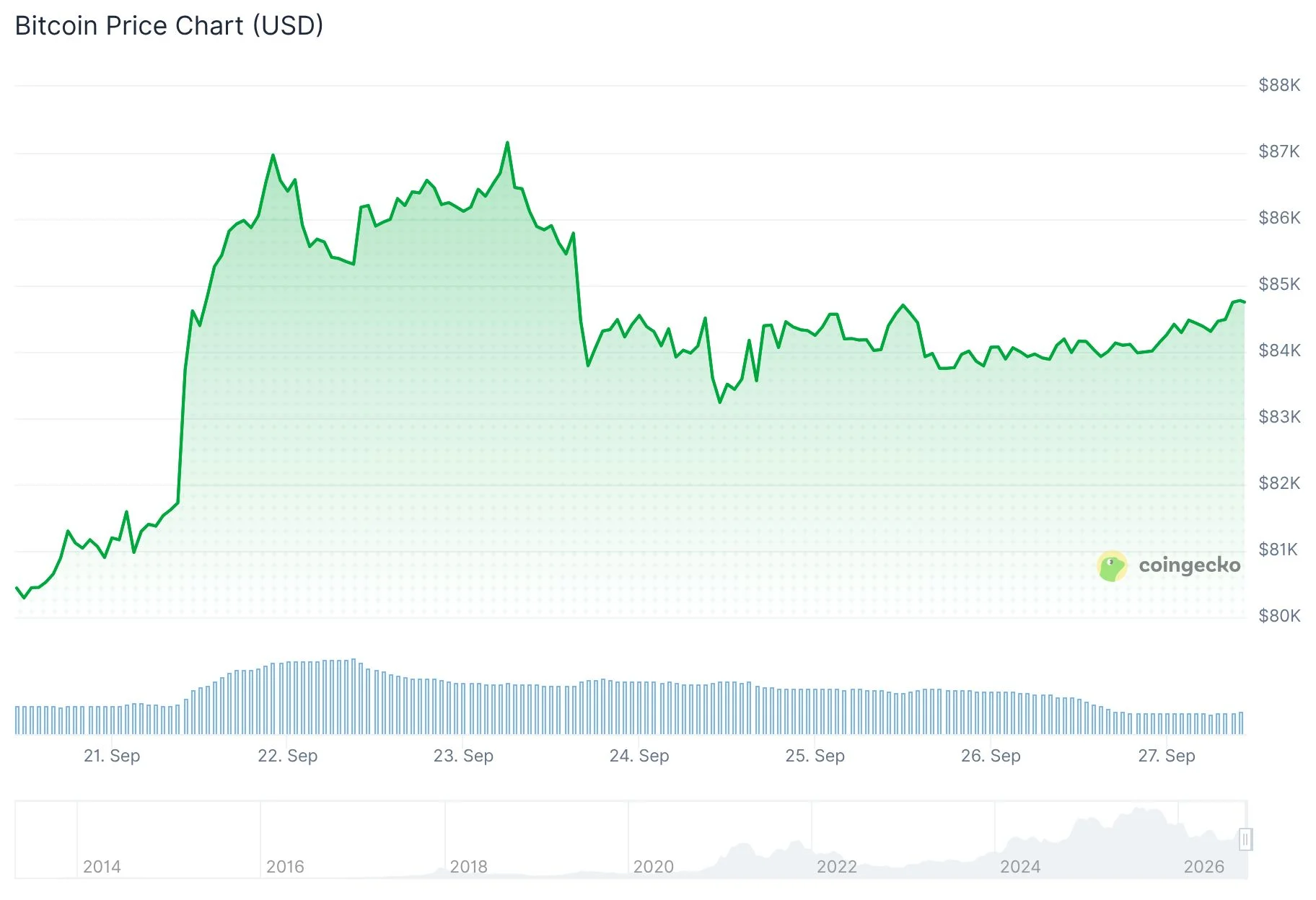
The leading cryptocurrency is approaching the conclusion of what stands as its second-most impressive third quarter in history. Since beginning July around $58,500, BTC has appreciated by approximately 43.5%.
This performance represents Bitcoin’s most robust Q3 showing since the 2017 quarter, during which it climbed roughly 80%. Meanwhile, Ethereum has outperformed even more dramatically this quarter with approximately 71% gains, positioning it for a record-breaking third quarter.
The cryptocurrency successfully navigated Friday’s substantial quarterly options expiration event without experiencing significant volatility. Spot market activity intensified throughout the week, while traders demonstrated restraint in taking profits.
Bitcoin ETFs Swing to Positive Year-to-Date Flows
Exchange-traded funds tracking spot bitcoin in the United States accumulated $2.4 billion during the week concluding September 25. This represents the most substantial weekly influx recorded since October 2025.

The strong performance pushed cumulative 2026 flows for bitcoin ETFs into positive territory. These investment vehicles had registered approximately $5.8 billion in net outflows as recently as mid-July.
The week’s opening session drove the majority of capital inflows. On Monday alone, the dozen tracked bitcoin ETFs absorbed $999 million, marking the highest single-session influx since October 2025.
Subsequent trading days witnessed progressively declining inflows. Tuesday’s session recorded $714.7 million, while Wednesday saw $347 million enter the funds. Thursday brought $190.6 million, and Friday concluded with $134.5 million.
BlackRock’s IBIT product dominated weekly flows with $1.2 billion in fresh capital. Fidelity’s FBTC captured $701.7 million, representing its strongest weekly performance since the beginning of September.
Ethereum-focused ETFs similarly reversed their trajectory last week. These funds attracted $689.9 million in new investments, contrasting sharply with the previous week’s $140 million in outflows.
Solana-tracking funds established a new benchmark on Friday, registering an $86.7 million single-day inflow that set a record for the product category.
Banking Sector Advocacy and Technical Warning Signs
Michael Saylor, Chairman of Strategy, advocated for expanded Bitcoin integration within the U.S. banking sector. His proposal centers on enabling financial institutions to provide Bitcoin custody services and issue loans collateralized by digital assets.
Saylor contended that existing capital regulations constrain meaningful bank involvement. He specifically highlighted the 1,250% risk weighting assigned to the highest-risk cryptocurrency positions under global banking frameworks.
His recommendations included establishing distinct regulatory frameworks for custody operations, lending activities, and direct institutional Bitcoin ownership.
Technical analyst Aksel Kibar expressed reservations regarding Bitcoin’s recent price behavior. “As we get close to end of week, the weekly candle does not look like a decisive breakout,” Kibar wrote, noting that genuine breakouts typically generate extended weekly candles, and the current hesitant movement could trigger a retreat into the previous trading range.
Security considerations remained prominent following the $387.5 million compromise of Bitget exchange infrastructure. By Saturday, the perpetrator had relocated approximately $83 million in stolen XRP from three separate wallets, according to CoinDesk reporting, with roughly $75 million remaining in the initially compromised accounts.
Ripple lacks the capability to freeze the compromised XRP directly, as the XRP Ledger’s freeze mechanisms do not extend to its native digital asset. Bitget representatives confirmed that its protection fund would absorb the losses and assured users that customer balances remain unaffected.
The exchange has scheduled Bitcoin withdrawal resumption for September 28, with Ethereum withdrawals planned for September 29 and USDT withdrawals set for September 30.
Get 3 Free Stock Ebooks
Discover top-performing stocks in AI, Crypto, and Technology with expert analysis.
- Top 10 AI Stocks - Leading AI companies
- Top 10 Crypto Stocks - Blockchain leaders
- Top 10 Tech Stocks - Tech giants


