



TLDR
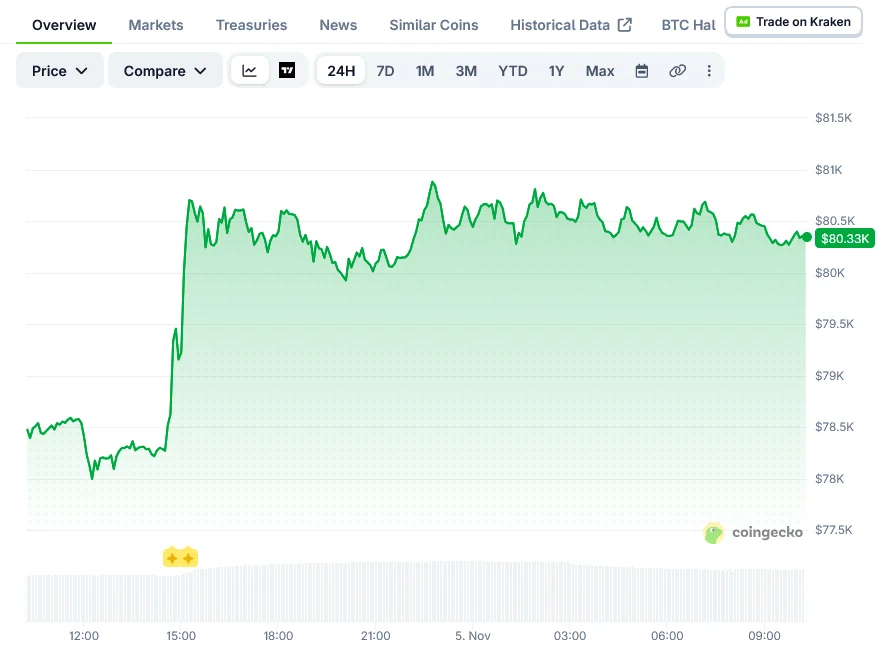
- Bitcoin was changing hands near $80,320 on November 5, posting a gain exceeding 3% across 24 hours.
- The digital asset had declined to approximately $75,600 as U.S. midterm election outcomes emerged.
- Spot Bitcoin exchange-traded funds registered $74.6 million in net inflows on November 4, breaking a three-day streak of capital exits.
- Fidelity’s FBTC product captured $236.7 million in new capital while BlackRock’s IBIT shed $201.2 million.
- Roughly $378 million worth of short positions faced forced liquidation in a single hour.
Bitcoin (BTC) was exchanging hands around $80,320 on November 5, reflecting gains exceeding 3% during the previous 24-hour period. This recovery followed a pullback toward $75,600 as vote tallies from the U.S. midterm elections were being reported on November 3.
The upward trajectory received support from renewed capital flowing into spot Bitcoin exchange-traded funds, strength in American equity markets, and a cascade of forced short position closures. BTC momentarily touched above $81,000 before stabilizing in the vicinity of the $80,000 threshold.
Democrats secured majorities in both the House and Senate during the midterm contests. Initial uncertainty among cryptocurrency market participants stemmed from expectations that Democratic legislators might adopt more stringent positions on proposed digital asset regulatory frameworks.
Market sentiment stabilized as participants digested the electoral outcomes. The S&P 500 index advanced approximately 1.6%, crude oil quotations declined, and diminished dollar strength combined with reduced Treasury yields to boost appetite for riskier asset classes.
Cryptocurrency market observer Ted commented that Bitcoin’s capacity to weather unfavorable developments indicated “the bottom is in.” However, he estimated only a 16% probability of reaching a fresh all-time peak by July 2027, suggesting any record might materialize later during that year.
A short squeeze phenomenon accelerated the price recovery. Information from CoinGlass revealed approximately $378 million in short positions underwent liquidation during a sixty-minute window, representing part of nearly $747 million in aggregate liquidations.
Short liquidations occur when trading platforms automatically close leveraged positions betting against an asset’s value. These traders face requirements to repurchase their positions, introducing additional buying momentum.
The upward movement extended throughout the cryptocurrency ecosystem. Ethereum (ETH) appreciated nearly 6% to reach approximately $2,425, XRP advanced 3% to $1.31, Solana (SOL) increased 4% to $96, and BNB added 2% to settle around $710.
Zcash (ZEC) outpaced other prominent cryptocurrencies, surging over 7% to approach $1,320. The token registered $1.2 billion in exchange volume across the preceding 24-hour span.
Fidelity Buys While BlackRock Sells
U.S.-based spot Bitcoin exchange-traded funds recorded $74.6 million in cumulative net inflows on November 4, based on data compiled by Farside Investors. This reversed three consecutive trading sessions of capital withdrawals, though the two largest fund providers exhibited divergent patterns.
Fidelity’s FBTC product drew $236.7 million, marking its strongest single-day inflow among recently reported sessions. ARK Invest’s ARKB captured $19.9 million, while Bitwise’s BITB secured $15.2 million.
BlackRock’s IBIT traveled in the opposite direction, experiencing $201.2 million in outflows. These withdrawals offset the majority of capital entering competing products.
The favorable session arrived after a challenging period for these investment vehicles. Market participants withdrew $643.2 million on October 30, $398.6 million on November 2, and $115.6 million on November 3.
Those three consecutive sessions extracted roughly $1.16 billion from Bitcoin ETF products. The November 4 inflows have recaptured only a modest fraction of that cumulative total.
Bitcoin Faces a Test at $82,000
On the daily timeframe, BTC trading around $80,688 remained positioned above the middle Bollinger Band located at $80,274. The Relative Strength Index climbed to 51.28, exceeding its moving average reading of 41.87.
Nearby resistance occupies the zone between $81,300 and $82,000, with the upper Bollinger Band positioned near $84,240 representing the next barrier. Downside support exists at the middle band, trailed by the lower band in the vicinity of $76,308.
CryptoQuant analyst CryptoZeno stated that Bitcoin has not yet exhibited conditions historically associated with a validated market bottom. He noted the Bitcoin Cycle Extremes Index dropped to 15.8% on its 30-day moving average, a measurement he categorizes within the “Watch / Mild Pressure” territory.
His Cycle Extreme Oscillator likewise remained beneath the 1.0 threshold connected to more robust market participation during previous market cycles. CryptoZeno emphasized that persistent improvement in both technical indicators would be necessary before he would characterize market conditions as genuinely strengthening.


