


Key Takeaways
- European Union energy officials have issued urgent warnings about a potential winter price shock stemming from Middle East conflict disruptions.
- Current gas reserves across the bloc stand at approximately 70% capacity, significantly trailing last year’s levels by 12 percentage points.
- The continent depends on imports for roughly 80% of its natural gas supply, creating vulnerability to global trade route interruptions.
- EU authorities have indicated member nations may reduce mandatory storage requirements from 90% to 80% using existing regulatory flexibility.
- Energy ministers received recommendations to implement conservation measures including reduced public heating, outdoor heating bans, and street lighting reductions.
European Union authorities are warning about an impending energy cost emergency during the upcoming winter season. These concerns stem from the ongoing conflict involving Iran, which has severely impacted global petroleum and natural gas trading.
Dan Jorgensen, who serves as the EU’s Energy Commissioner, distributed correspondence to energy policy leaders throughout member nations. Both Reuters and Bloomberg obtained and reviewed the document’s contents.
“We are confronting a pricing emergency connected to supply chain disruptions,” Jorgensen stated in his communication.
Factors Driving Energy Cost Increases
The European continent depends heavily on external sources for its energy requirements. Foreign imports account for approximately 80% of total gas consumption across the union.
This substantial reliance creates significant exposure whenever international shipping channels face obstacles. Under normal circumstances, the Strait of Hormuz facilitates passage for roughly one-fifth of global petroleum and liquefied natural gas shipments.
The current military situation has essentially blocked this critical waterway. Consequently, energy costs throughout European markets have climbed substantially.
Natural gas prices across Europe have increased by more than 100% since the U.S.-backed military action against Iran commenced in late February. Earlier this month, trading levels reached their peak since the closing months of 2022.
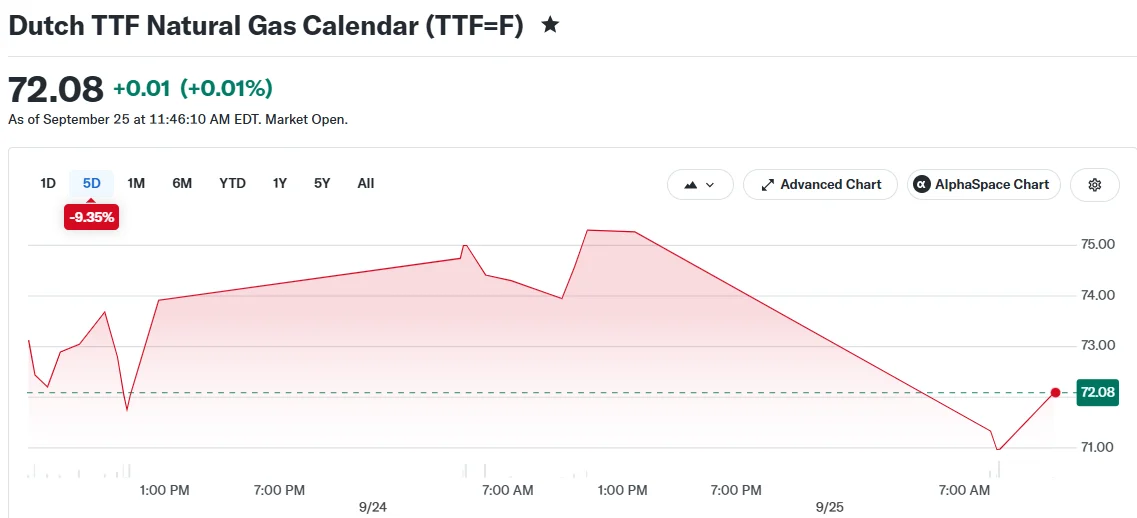
While Europe isn’t experiencing an immediate supply deficit, the elevated pricing structure is creating significant challenges for nations attempting to reach storage capacity goals before the heating season begins.
Reserve Levels Trail Seasonal Benchmarks
Aggregate gas storage throughout the European Union currently measures around 70% of total capacity. This represents a decline of 12 percentage points compared to the corresponding timeframe in the previous year, based on information from Gas Infrastructure Europe.
These levels also fall short of the typical seasonal average of 86%. Elevated short-term market prices have substantially increased the financial burden for governments attempting to continue filling reserves throughout the summer period.
Jorgensen acknowledged that the EU finds itself in a stronger position compared to the 2021 emergency situation. During that period, Russia curtailed gas shipments to Europe, triggering widespread supply difficulties.
In the intervening years, Europe has expanded its infrastructure for importing liquefied natural gas. The region has simultaneously invested in additional renewable power generation and successfully decreased total gas consumption.
Even with these improvements, Jorgensen emphasized the need for governments to intensify winter readiness efforts. Heating requirements traditionally surge during the coldest seasonal periods.
He noted that nations could utilize adaptability mechanisms incorporated within EU gas storage regulations. These provisions would permit countries to adjust their capacity targets downward from 90% to 80%.
Implementing this modification could alleviate market pressure and reduce the financial burden associated with refilling storage facilities.
Jorgensen additionally encouraged governments to maintain gas injections into storage infrastructure when appropriate. He requested that countries implement reductions in both gas and electricity consumption for whatever duration proves necessary.
Recommended actions encompass temperature restrictions within government buildings. Officials additionally proposed prohibiting outdoor heating systems and deactivating non-essential public illumination.
A representative from the European Commission had not provided commentary regarding the correspondence at the time of publication.
The communication underscores increasing apprehension among EU leadership as the winter season draws closer. Energy policy officials throughout member countries are currently evaluating the proposed recommendations.


